Does a Face Massager Improve Product Absorption More Than Hands?

A face massager may improve surface spreading more than true absorption; for many serums and moisturizers, clean fingers are often just as effective and can be gentler. Used poorly, a tool can irritate skin, waste product, or tempt you to rub too hard. This guide separates spreading from absorption and matches the method to product type and skin sensitivity.
Face massager vs hands: absorption or spreading?
Most of what people call “better absorption” is really thinner, more even spreading across the skin. That can make a product disappear faster on the surface, but it does not mean more active ingredients moved past the outer layer. Hands usually win for control and warmth; a face massager can help when you want a smooth, even film.
Why a thin layer can look absorbed before it is actually absorbed
A product may stop looking shiny because it has been spread into a thinner layer, not necessarily because it has penetrated more deeply. This matters most with lightweight formulas, where a flat, even finish can be mistaken for faster absorption. Absorption often depends more on the formula, skin condition, and contact time than on the applicator alone.
What hands do better than a device
Clean hands adapt to texture. Fingers can warm a lotion, adjust pressure instantly, and stop before a product is rubbed off the skin. They also spread small amounts well, which matters when you are layering actives and do not want extra friction.
What a face massager can do better than fingers
A face massager can distribute thicker product more evenly over broad areas, especially if it has a flat head or smooth rolling contact. It may help on drier cheeks or along the jaw where an even film is harder to place with fingertips. That advantage is about coverage, not guaranteed penetration.
Comparison table: skincare textures
| Texture | Best application method | Face massager helps or hinders? | Pressure level | Main risk to watch for |
|---|---|---|---|---|
| Serum | Clean fingertips | Usually hinders if it adds friction | Very light | Rubbing off a thin layer or causing pilling |
| Essence | Hands or palms | Usually neutral to slightly helpful for even spread | Light | Overworking the skin before the layer settles |
| Lotion | Hands first, device only if needed for spread | Can help on dry areas | Light to moderate | Moving product off the face if pressure is too high |
| Cream | Hands or a clean flat head | Often helps with even coverage | Light to moderate | Extra friction on sensitized or exfoliated skin |
| Facial oil | Hands, then gentle smoothing if needed | Usually neutral; can help with glide | Very light | Leaving an occlusive film that is pushed around instead of set |
When hands usually work better
Hands are usually better for serums, essences, and any routine built around sensitivity control. They are warmer, more adaptable, and easier to stop immediately if skin starts to sting. They also reduce the chance of pushing product away from areas that need it most.
Serums and essences
Thin formulas spread quickly. That makes them easy to overwork. Fingers can place a small amount, then pat or lightly smooth it without lifting much product back off the skin. A tool often adds more motion than a serum needs.
Sensitive or reactive skin
When skin is easily irritated, pressure control matters more than glide. Hands give the most precise feedback, so you can use a feather-light touch and stop if redness appears. A face massager may feel too firm even when it seems gentle in the hand.
After exfoliation or when the barrier is stressed
Fresh exfoliation, peeling, wind burn, or a stressed barrier can increase friction risk. In that state, extra rubbing can worsen stinging and prolong redness. Use the least mechanical force possible, which usually means fingertips rather than a moving device.
When a face massager can help
A face massager can help when the product is thicker, the skin is dry, or you need more even coverage than fingers can give. The best cases are those where the tool spreads product without adding much drag. That usually means a clean surface, gentle contact, and no repeated passes.
Lotion and cream textures
Lotions and creams have more body than serums. A smooth, flat contact surface can help distribute them across cheeks, forehead, and neck without leaving clumps. The tool should glide, not scrub. If it feels sticky, stop and switch to hands.
Facial oils and occlusive finishes
Oils already create slip, so a device can move them far more than needed. Light hand pressure is usually enough. A face massager only makes sense if you are trying to spread a very small amount evenly over dry patches, and even then the pressure should stay minimal.
Even spreading on drier areas
On rough or parched zones, thicker product can collect unevenly. A clean roller or flat head may help distribute it in a thin layer without piling it up in one spot. That is a coverage benefit, not a sign that the skin is absorbing more.
Does a face massager improve serum absorption?
Usually no, not in a meaningful way. Serums are often thin enough that clean fingers already spread them efficiently, and extra movement can reduce the amount left on the skin. If the serum is active-heavy or low-viscosity, friction matters more than the applicator.
The role of viscosity and slip
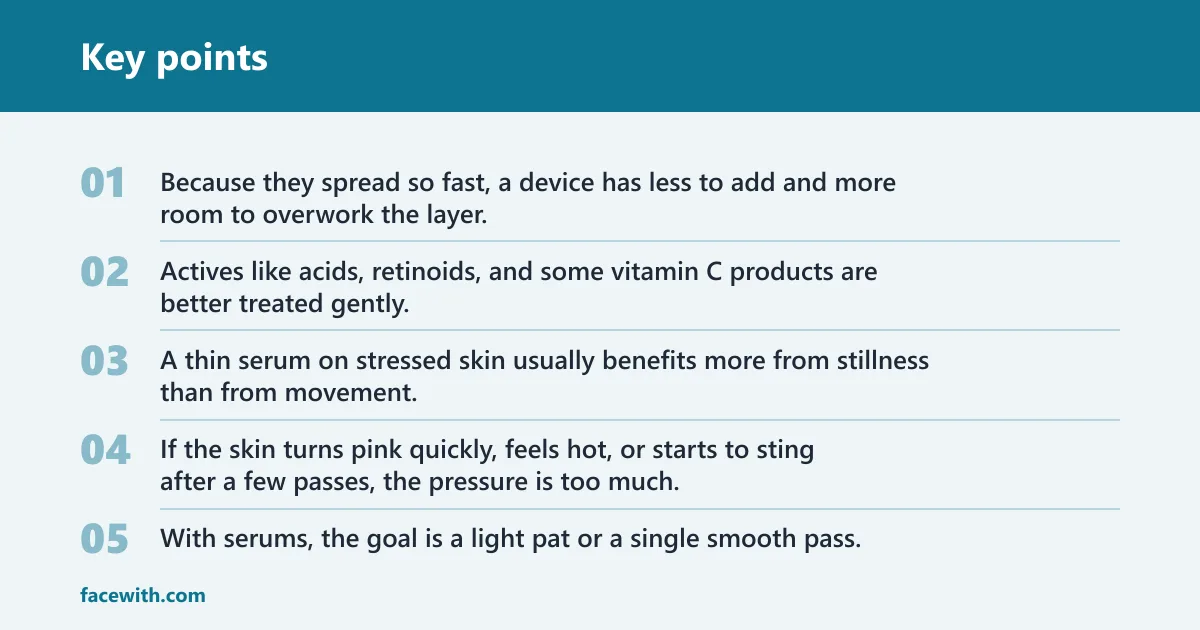
Low-viscosity serums move easily. Because they spread so fast, a device has less to add and more room to overwork the layer. If the formula has high slip, the risk is not poor spread; it is pushing the product around until too little stays where you applied it.
When friction works against a serum
Actives like acids, retinoids, and some vitamin C products are better treated gently. The issue is not that massage blocks absorption in every case; it is that repeated rubbing can irritate skin and make the application less even. A thin serum on stressed skin usually benefits more from stillness than from movement.
How much pressure is too much?
If the skin turns pink quickly, feels hot, or starts to sting after a few passes, the pressure is too much. With serums, the goal is a light pat or a single smooth pass. Anything that requires repeated back-and-forth strokes is usually more force than the formula needs.
Should you use a face massager after moisturizer?
Usually only if you want gentle spreading, not because moisturizer needs help “absorbing.” After moisturizer goes on, further massage can shift it off the skin, thin the layer, or create pilling if the base does not tolerate friction. Light pressure may be fine for a rich cream on dry areas.
Moisturizer layering order
Apply treatment products first, then moisturizer, then any occlusive finish if your routine uses one. That order keeps the more active layers closest to clean skin. A device after moisturizer can disturb this structure if it keeps moving the top layer around.
How massage can move product off the skin
Moisturizers often contain waxes, silicones, or emollients that spread well but do not need repeated motion. A tool can drag that film away from the driest spots and pile it along the hairline or jaw. If the face looks patchy after a pass, stop massaging.
When light pressure still makes sense
Very light smoothing can help if a cream is sitting unevenly on dry cheeks or around the nose. Use one or two slow passes only. If the skin is already soft, warm, and evenly coated, more movement usually adds friction without adding benefit.
Choose hands if… / Choose a face massager if…
Hands are the safer default for most routines. A face massager has a narrower job: even spread on thicker textures, with clean contact and low pressure. The better choice depends on the formula, the skin barrier, and how much control you need over the layer you are applying.
- Choose hands if you want warmth and control. Clean fingers spread small amounts well, adapt to face shape, and let you stop immediately if skin starts to sting.
- Choose hands if your skin is sensitive. This matters after exfoliation, when skin is reactive, or when you are using acids and other active ingredients that do not need extra friction.
- Choose a face massager if the texture is thick. Lotions and creams can spread more evenly with a clean flat head or smooth roller, especially on dry cheeks or the neck.
- Choose a face massager only if you can keep it clean. Reusable devices need cleaning between uses, and shared tools carry contamination risk if they are not disinfected properly.
Clean hands and device hygiene
Hygiene affects both comfort and product performance. Dirty fingers can transfer oil, debris, or microbes to skin, and a reused tool can carry residue from the last session. Clean hands and a clean device are not optional extras; they are part of the application method.
-
Wash with soap.
Use soap and water before applying skincare. Dry your hands fully before touching product, because wet fingers can thin formulas too much and make them slide around instead of staying in place.
-
Check nails and roughness.
Keep nails short enough that they do not scratch the skin or scrape product away. Rough edges, hangnails, and dirty nail tips all increase irritation risk, especially around the nose and under the eyes.
-
Clean the device after use.
Wipe reusable tools according to the manufacturer’s material guidance. A smooth nonporous head is easier to clean than a textured one, and water-based cleaners may not be suitable for every electric device.
-
Disinfect between users.
Avoid sharing a face massager unless it has been properly cleaned and disinfected. Shared-use contamination is a real risk because residue can stay in seams, rollers, or charging crevices if the device is not maintained carefully.
Say your routine uses a watery serum with a pH-sensitive active and your skin is slightly flaky from exfoliation. Clean hands are the better tool. A flat device may look efficient, but the extra passes can irritate the barrier and leave less product on the face.
Suppose you are applying a thick cream to dry cheeks and a normal forehead after cleansing. A clean face massager can help smooth the cream evenly on the cheeks, while fingertips can finish the rest. One method is not better everywhere on the face.
Frequently asked questions
Does a face massager improve product absorption more than hands?
Usually not. A face massager is more likely to improve surface spreading than true absorption. Hands are often just as effective for most serums and moisturizers, and they give better pressure control. If the skin is sensitive, hands are usually the safer choice.
Is serum absorbed better with a face massager or hands?
For most serums, hands are the better default. They spread a thin formula without as much friction, which matters more than any small difference in perceived absorption. A face massager can push a serum around too much, especially if the skin is already irritated.
Should you use a face massager after applying moisturizer?
Only if the goal is very light smoothing on a thick cream. After moisturizer, extra massage can move product off the skin, create patchy coverage, or cause pilling. If you use a device, keep pressure minimal and stop as soon as the cream is evenly placed.
Does massage help skincare products absorb faster?
Sometimes it helps a product spread faster, but that is not the same as deeper absorption. The formula, viscosity, and skin condition matter more than massage. Repeated rubbing can also irritate the barrier, which is a poor trade if you are using active ingredients.
Can a face massager waste product by moving it around the skin?
Yes. This is most likely with thin serums, lotions applied too generously, or oily formulas with a lot of slip. The product may gather at the hairline, jaw, or around the nose instead of staying where you intended. That is spreading failure, not better absorption.
Are hands better than a face massager for sensitive skin?
Usually yes. Clean hands give the lightest, most adjustable pressure and are easier to stop mid-application. Sensitive or post-exfoliation skin tends to do better with less friction, fewer passes, and a method that does not drag product across the surface repeatedly.