Ionic vs Ceramic Hair Dryer: Which Is Better?

Ionic is better for faster drying and frizz control, while ceramic is better for even, gentler heat; choose ionic for thick, coarse, or very frizz-prone hair, and ceramic for fine, damaged, or color-treated hair. Pick the wrong one and you can end up with flat roots, extra frizz, or more heat exposure than your hair needs. This guide matches each dryer type to hair texture, styling goals, and the features that matter most.
| Decision factor | Ionic | ceramic hair dryer | Winner |
|---|---|---|---|
| Drying speed | Usually faster; ionic drying speed is commonly ranked fast | Usually steadier but slower; ceramic is commonly ranked medium | Ionic |
| Frizz control | Excellent for static and smoothing | Moderate on its own | Ionic |
| Shine and polished finish | Often marketed for smoother, glossier results | Can smooth well, but usually with less dramatic finish | Ionic |
| Volume retention | Can flatten fine hair or leave roots limp | Usually easier to keep body and lift | ceramic hair dryer |
| Heat feel | Can dry quickly with less time under heat, but result depends on airflow and settings | More even, gentler-feeling warmth | ceramic hair dryer |
| Hot-spot risk | Varies by build quality and nozzle use | Ceramic heat distribution is commonly ranked excellent | ceramic hair dryer |
| Best hair types | Thick, coarse, dense, very frizz-prone | Fine, damaged, color-treated, daily blow-dry routines | tie |
| Likely downside | Over-smoothing, flat roots, less bounce | Can feel slow on dense hair | tie |
| Ideal attachments | Concentrator for sleek blowouts; diffuser if curls need frizz control | Diffuser for curls and waves; concentrator for controlled shaping | tie |
Ionic vs ceramic at a glance
Drying speed
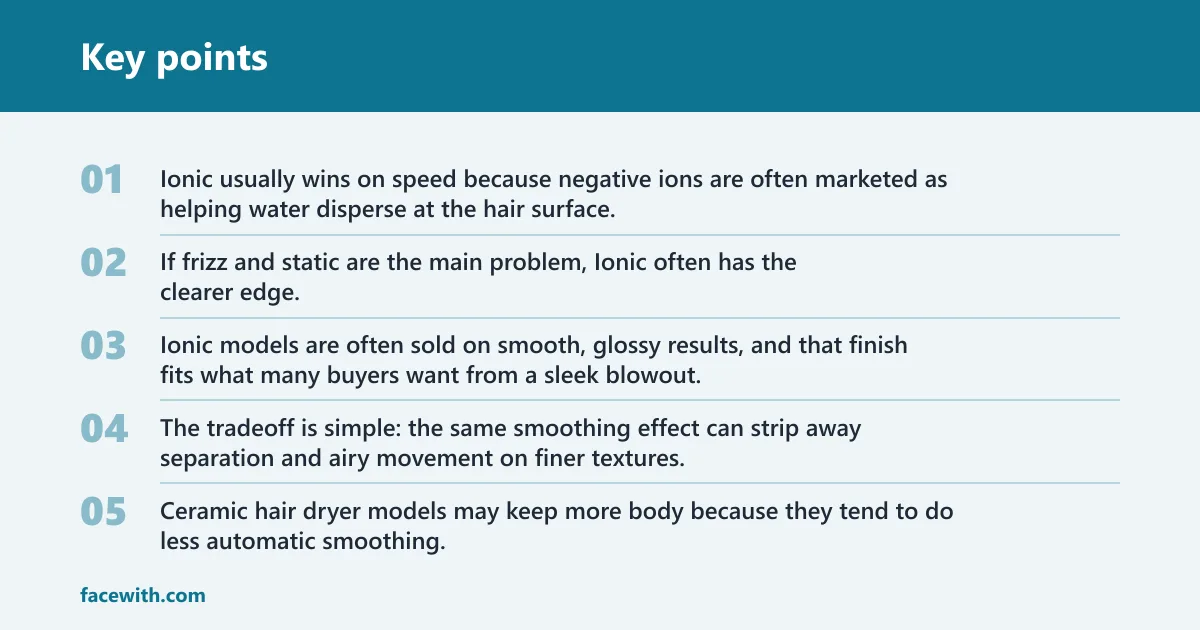
Ionic usually wins on speed because negative ions are often marketed as helping water disperse at the hair surface. Some product pages claim ionic technology can cut drying time in half, but motor strength, airflow, and hair density still decide whether you actually notice that gap.
Frizz control
If frizz and static are the main problem, Ionic often has the clearer edge. That difference is large enough to matter when humidity or rough cuticles are part of your daily routine.
Shine and polished finish
Ionic models are often sold on smooth, glossy results, and that finish fits what many buyers want from a sleek blowout. The tradeoff is simple: the same smoothing effect can strip away separation and airy movement on finer textures.
Volume retention
Ceramic hair dryer models may keep more body because they tend to do less automatic smoothing. That matters most at the roots, where fine or thin hair can lose lift fast when airflow is strong and the ionic effect is heavy.
Heat feel
Ceramic heating elements, and some ceramic-coated components, tend to warm more uniformly across the dryer, so one section is less likely to get a blast of sharper heat than the next. That steadier heat feel is why ceramic is often positioned for everyday use, especially when you are drying bangs, fragile ends, or sections that need several passes.
Hot-spot risk
Ceramic has the edge here because even heat delivery is the main point of the material. A basic regular blow dryer relies on heat and airflow without ionic or ceramic technology, and that helps explain why basic models often feel less controlled.
Best hair types
Neither label wins for everyone. Thick, coarse, and highly frizz-prone hair often benefits from Ionic, while fine, damaged, and color-treated hair often does better with ceramic or a mild hybrid that offers low heat and moderate airflow.
Likely downsides
The main Ionic failure case is over-smoothing. The main ceramic hair dryer failure case is slow rough-drying, especially when hair is dense enough that you feel pushed to turn the heat up just to make progress.
Ideal attachments
Attachments often matter more than the label once you narrow the field. A concentrator narrows and directs the air stream, which can help smooth one section at a time and shape ends or roots with more control, while a diffuser spreads airflow for curls and waves so they are less likely to lose their pattern.
What is the real difference between ionic and ceramic?
Ionic changes the finish and often the drying speed, while ceramic changes how the heat is delivered. In practice, Ionic is about frizz control and often faster drying; ceramic is about more even warmth, fewer hot spots, and easier day-to-day control on hair that dislikes harsh heat.
How Ionic affects the result
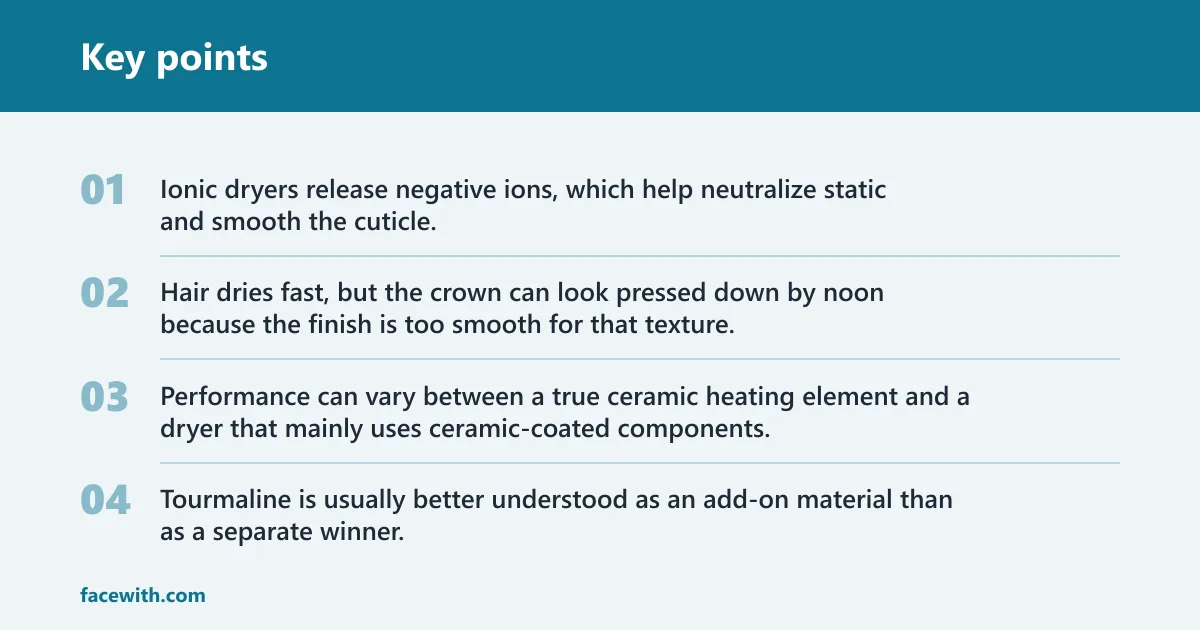
Ionic dryers release negative ions, which help neutralize static and smooth the cuticle. That is why they are so often chosen for shinier, sleeker results. It is also why they can leave fine hair looking flatter than expected when you want root lift more than polish.
A common first-timer mistake is buying the strongest Ionic model for shoulder-length fine hair, then using high speed at the roots with a concentrator. Hair dries fast, but the crown can look pressed down by noon because the finish is too smooth for that texture.
How ceramic changes the heat
Ceramic dryers use ceramic heating elements or ceramic-coated parts that release heat more steadily across the airflow path, so one pass is less likely to create hotter patches than another. Performance can vary between a true ceramic heating element and a dryer that mainly uses ceramic-coated components. The value is predictability. You get a steadier feel section to section, which can help when hair is fragile, overprocessed, or easy to overdry at the ends.
Where tourmaline fits
Tourmaline is usually better understood as an add-on material than as a separate winner. In hybrid dryers, it may help emit negative ions and is often tied to far-infrared warmth, a marketed effect usually framed as gentler, more even heat rather than a totally different styling result.
Many strong picks are hybrids. A dryer can be both Ionic and ceramic, and plenty of models combine those traits with tourmaline parts so you get smoothing plus more even heat instead of choosing one label in pure form.
Which dries faster: ionic or ceramic?
Ionic usually dries hair faster, but the label does not decide the whole result. Motor type, airflow consistency, nozzle design, section size, and how dense your hair is can outweigh the tech claim, especially when you compare a strong ceramic model with a weak Ionic one.
Why Ionic usually wins on time
Ionic often dries hair faster. That lines up with the core claim: ions are often marketed as helping moisture disperse more quickly, so you may spend less total time blow-drying.
Why motor type can matter more
Professional ionic models typically use AC motors, while many budget models use DC motors. Newer high-speed dryers often use brushless motors. For buyers, the difference shows up as airflow consistency, expected longevity, weight, noise, and price tier, not just raw heat.
A weak motor with an Ionic badge can still feel slow.
Why dense or coarse hair changes the answer
Suppose your hair is coarse, mid-back length, and dense enough that a towel-dry still leaves it very wet after five minutes. In that case, stronger airflow plus Ionic smoothing usually beats ceramic alone, because the problem is moving water out fast before repeated passes pile up heat exposure.
Which is better for frizz, volume, and finish?
Ionic is usually better for frizz and sleekness, while ceramic hair dryer models are usually better for volume control and a more natural finish. The right pick depends on whether you want smooth cuticles and shine or more lift, bounce, and margin for styling error.
Frizz and static control
For frizz, Ionic is the stronger choice. Negative ions are commonly described as helping reduce static and smooth the hair surface, and basic dryers are often said to offer less frizz control, which can make the difference between basic and Ionic models easier to notice.
Volume retention and root lift
If root lift matters, ceramic often makes life easier. You still need technique, but the dryer is less likely to over-smooth the roots before you shape them. That is one reason many people with fine hair prefer ceramic or a hybrid with a mild Ionic setting they can dial back.
Shine, smoothness, and over-smoothing
Ionic usually gives the sleeker finish. That is great for puffy blowouts, coarse textures, and humid climates. It can be less great when you want fullness, soft texture, or curls that keep spring instead of stretching looser as they dry.
Which is better for your hair type?
Ionic is usually better for thick, coarse, and very frizz-prone hair, while ceramic hair dryer models are usually better for fine, damaged, and color-treated hair. Curly and wavy hair can go either way, depending on whether your top goal is frizz control, curl definition, or preserving volume.
Fine and thin hair
Fine hair often benefits from low heat and gentler, even warmth. Some manufacturers explicitly warn that a turbo Ionic switch is not recommended for fine, thin hair. That does not make Ionic wrong across the board, but it does make strong Ionic output a common mismatch when body is the goal.
Thick or coarse hair
Thick hair usually wants stronger airflow first, then enough heat to keep the process moving. Ionic often fits well because it speeds drying and smooths the rougher cuticle that can make coarse hair look bulky or fuzzy after a long blow-dry.
Curly and wavy hair
For curls and waves, the best label depends on the finish you want. Ionic plus a diffuser can reduce halo frizz, while ceramic plus a diffuser can give a softer, less stretched result. If curls go limp easily, ceramic or a low-ion hybrid is often the safer bet.
Damaged and color-treated hair
Damaged or color-treated hair usually does best with low to medium heat, higher airflow before higher heat, and fewer repeat passes. Ionic can still work here, especially if frizz is severe, but heavy smoothing can make weakened fine hair look limp, so settings matter more than the label.
Hair type decision table
| Hair type | Better type | Likely downside | Best settings | Buy/no-buy rule |
|---|---|---|---|---|
| Fine | ceramic hair dryer | Ionic can flatten roots and reduce body | Low heat, medium speed, concentrator only for ends and fringe | Buy ceramic if volume matters; no-buy on strong Ionic-only models with turbo smoothing as the main pitch |
| Thick | Ionic | ceramic hair dryer can feel slow and tempt you into extra heat time | Medium to high airflow, medium heat, concentrator for smoothing | Buy Ionic if dry time is a pain point; no-buy on low-airflow ceramic models |
| Curly | Ionic | Too much smoothing can loosen pattern | Low to medium heat, low speed, diffuser | Buy Ionic if frizz is the bigger issue; no-buy if your curls drop quickly after drying |
| Frizzy | Ionic | Can reduce fullness if hair is also fine | Medium heat, medium speed, concentrator for sleek styles | Buy Ionic when static and puffiness are daily problems; no-buy if you mainly want airy volume |
| Damaged | ceramic hair dryer | Drying may take longer on dense hair | Low heat, medium airflow, keep the dryer moving | Buy ceramic for daily use; no-buy on hot, single-setting dryers of any type |
| Color-treated | ceramic hair dryer | Ionic can over-smooth fine color-treated hair if used too hot | Low to medium heat, medium airflow, finish cool | Buy ceramic unless your hair is also very coarse and frizz-prone |
What features matter more than ionic or ceramic?
Once you know your hair goal, the better buy often comes down to motor, settings, and attachments more than the label itself. A well-built dryer with the right controls will usually beat a poorly built one with the trendier technology badge.
Motor type: AC, DC, and brushless
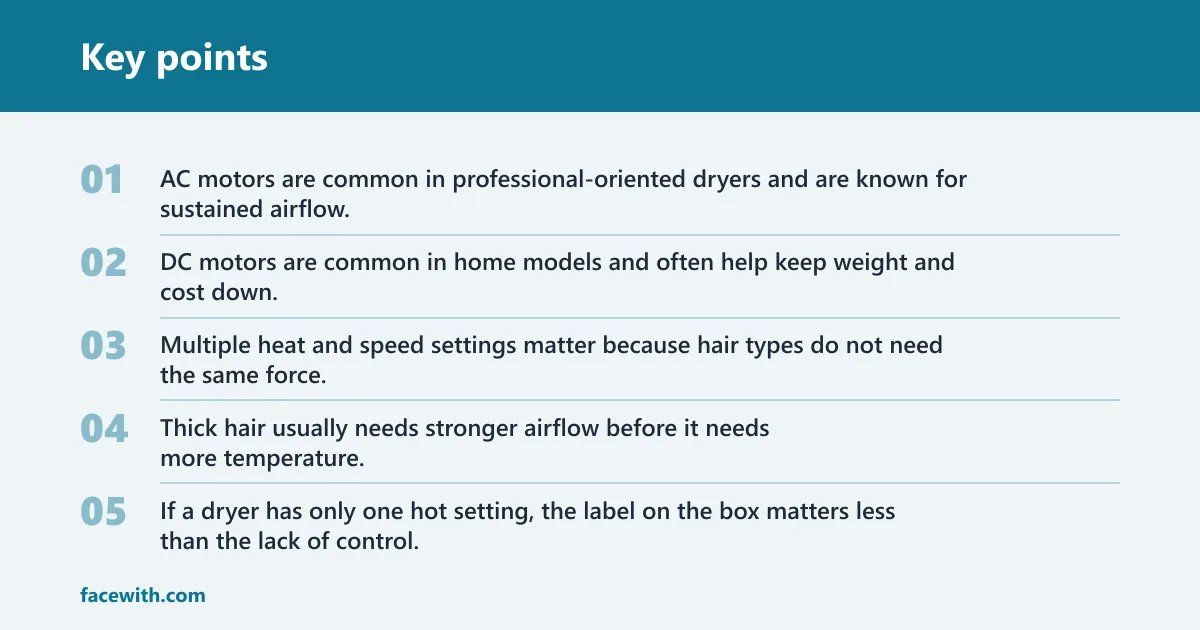
AC motors are common in professional-oriented dryers and are known for sustained airflow. DC motors are common in home models and often help keep weight and cost down. Brushless motors show up in newer high-speed dryers and are usually tied to premium pricing, lighter builds, and more consistent airflow.
Heat and speed settings
Multiple heat and speed settings matter because hair types do not need the same force. Fine or damaged hair benefits from low heat. Thick hair usually needs stronger airflow before it needs more temperature. If a dryer has only one hot setting, the label on the box matters less than the lack of control.
Diffuser and concentrator attachments
A diffuser supports curls and waves by spreading air and lowering blast intensity. A concentrator narrows the airflow into a tighter stream, which helps you smooth the cuticle with a brush, shape bangs, and aim air at the roots or ends instead of the whole head at once. If you switch between curly and sleek styles, attachments may matter more than choosing a pure Ionic or pure ceramic design.
Weight, noise, and home-use comfort
Home users often care most about comfort, simple controls, and tolerable noise. Pro-style buyers usually care more about all-day durability and sustained airflow. If you blow-dry at home a few times a week, a lighter ceramic or hybrid model may suit you better than a heavier professional Ionic dryer.
Choose Ionic if… / Choose ceramic hair dryer if…
Choose Ionic if…
- Your hair is thick, coarse, dense, or very frizz-prone.
- You want faster rough-drying before a brush finish.
- Your main goal is a smoother, shinier blowout with less static.
- You do not mind trading some root fullness for a sleeker finish.
Choose ceramic hair dryer if…
- Your hair is fine, damaged, or color-treated.
- You blow-dry often and want more even, gentler heat.
- You care about volume retention and less risk of limp roots.
- You want a dryer that feels easier to control section by section.
Choose a hybrid if you want both traits
A hybrid often makes the most sense. Ceramic plus Ionic gives you even heat and smoothing in one tool, and tourmaline is commonly added to boost ion output and far-infrared warmth. For many buyers, that is the real sweet spot rather than chasing a pure category.
How to choose between ionic and ceramic for your needs
Choose by your main result first, then filter by hair type, settings, and motor quality. If you start with the marketing label alone, it is easy to buy a dryer that technically sounds better but gives the wrong finish on your actual hair.
A quick buying method
- Name your main goal. Pick one priority: faster drying, less frizz, more volume, gentler daily use, or curl definition. If you want speed and smoothing, start with Ionic; if you want control and softer heat feel, start with ceramic hair dryer models.
- Match it to texture. Fine, damaged, and color-treated hair usually leans ceramic hair dryer. Thick, coarse, or highly frizzy hair usually leans Ionic. If your hair sits between categories, look for a hybrid with multiple settings.
- Check the controls. Make sure you get at least low heat and more than one speed. Low heat matters for fine hair, while stronger airflow helps thick hair dry without dragging out the session.
- Pick the right attachment. Choose a diffuser for curls and waves, or a concentrator for smoothing and shaping. The wrong attachment can cancel out the benefit of the dryer technology you paid for.
- Use comfort as a tiebreaker. If two dryers fit your hair equally well, choose by weight, noise, and motor type. A lighter, quieter dryer that you will actually use correctly beats a heavier one with better marketing language.
Say your hair is fine, collarbone length, and color-treated, and your complaint is flat ends plus flyaways near the part. A ceramic hair dryer with low heat and a narrow concentrator is the safer first pick, because the problem is controlled smoothing without crushing the roots.
Frequently asked questions
Is an ionic hair dryer better than a ceramic hair dryer for my hair?
Ionic is better if your hair is thick, coarse, or very frizz-prone and you want faster drying with a smoother finish. ceramic hair dryer is better if your hair is fine, damaged, or color-treated and you want more even heat, more volume retention, and easier daily control.
Which hair dryer is better for frizzy hair, ionic or ceramic?
Ionic is usually better for frizzy hair because negative ions help reduce static and smooth the cuticle. ceramic hair dryer can still work well, especially with a concentrator and good technique, but it usually will not calm puffiness as effectively as a comparable Ionic model.
Which hair dryer is better for fine hair, ionic or ceramic?
ceramic hair dryer is usually the safer choice for fine hair because it gives more predictable heat and is less likely to flatten the roots. Ionic can work if settings are mild, but strong smoothing can make fine hair look limp, especially at the crown.
Which hair dryer dries hair faster, ionic or ceramic?
Ionic usually dries hair faster. That said, airflow and motor quality can matter as much as the label. A strong ceramic dryer may outperform a weak Ionic one, especially if the Ionic model has poor airflow, limited settings, or a nozzle that does not move much air.
Do ceramic hair dryers damage hair less than ionic ones?
Not automatically. Damage risk depends more on total heat exposure, airflow strength, distance from the hair, and repeated passes. ceramic hair dryer often feels gentler because the heat is more even, while Ionic may reduce total exposure by shortening drying time. The better choice depends on your hair and technique.
Can a hair dryer be both ionic and ceramic?
Yes. Many of the better home and pro-style dryers are hybrids that combine Ionic smoothing with ceramic heat distribution. That setup makes sense if you want faster drying and frizz control but still want the more even warmth associated with ceramic designs.