Best Hair Dryer for Frizzy Hair: Top Picks

A commonly recommended hair dryer for frizzy hair is an ionic dryer with about 1,800 watts, multiple heat settings, two speeds, and a concentrator; ceramic is often suggested for fine hair and a diffuser for curls. Choose badly, and you may swap frizz for heat damage, limp roots, slow drying, or blown-out ends. This guide matches hair type, porosity, and styling habits to the dryer features that matter most, then points you to strong picks for smoother results.
Why this all-purpose dryer suits most frizz-prone hair
Shark Ionic SpeedStyle is the clearest overall pick for most frizz-prone hair because CNET lists it as the best hair dryer overall, and that broad ranking fits shoppers who need quick drying, directed airflow, and attachment-based styling without jumping straight to a curl-specific or ultra-premium niche model.
Why this feature set works for the widest range of frizz-prone hair
For most people, frizz control starts with a concentrator that pushes air from roots to ends, plus heat settings low enough to dry the cuticle flat instead of blasting it open. A dryer works better when it combines ionic frizz reduction, multiple heat and speed settings, and a nozzle that sends air downward along the hair shaft.
That matters more than hype around one headline spec. Full-size dryers are commonly found in about the 1600W to 2200W range, but wattage alone does not tell you how smooth the finish will look. Nozzle shape, motor speed, and temperature regulation matter just as much.
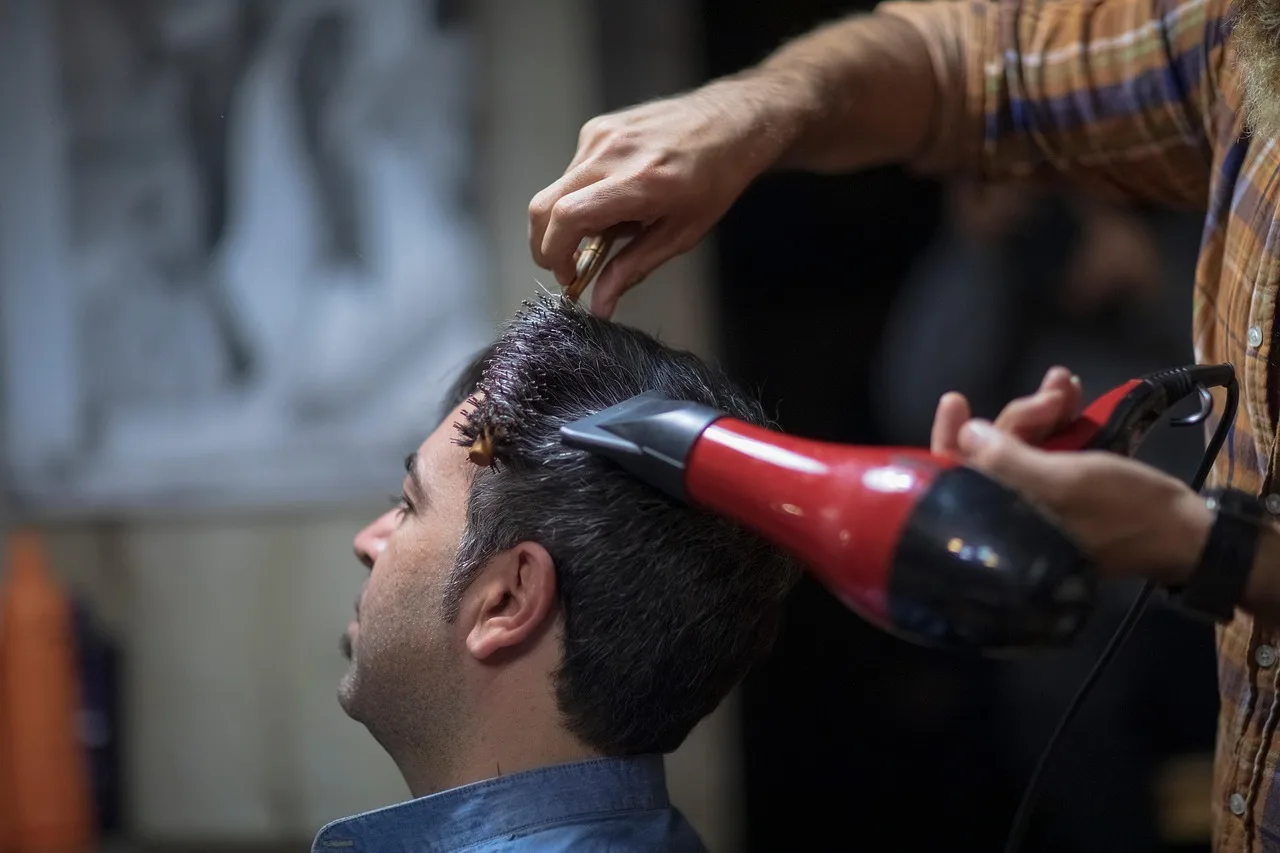
ELLE recommends a classic blow dryer with a tight nozzle for frizzy hair, and it advises pairing that nozzle with a round brush. That remains the default setup when the goal is a smooth blowout rather than curl preservation.
Who should skip it and choose a more specific option?
Skip a generalist pick if your hair has one clear limiting factor. Fine, heat-sensitive hair usually does better with gentler ceramic heat and lower airflow. Very thick hair may need stronger output. Wavy or curly hair that frizzes when brushed often needs a diffuser, not a concentrator-led blowout.
Damaged or color-treated hair should move heat control systems and lower end-of-dry temperatures higher on the checklist. Frequent travelers should care more about weight and voltage than brand rank.
The minimum specs to look for if this exact pick is unavailable
- Ionic technology. Common in midrange to premium dryers, and useful for reducing static and pushing hair toward a smoother finish.
- At least 1,800 watts. A practical baseline for many smooth blowouts on medium to thick hair.
- Three heat settings and two speeds. Enough range to avoid over-drying fine or damaged sections while still moving quickly through denser hair.
- Concentrator nozzle. The default attachment for frizz control during straight or polished styles.
- Cool shot button. Use it on dry, shaped sections to lock in bend or smoothness without another pass of heat.
- Removable filter. Important for long-term airflow, because lint buildup can cut performance over time.
Quick picks
| Best for | Pick | Concrete spec or ranking | Price tier |
|---|---|---|---|
| Most frizzy hair | Shark Ionic SpeedStyle | CNET lists it as the best hair dryer overall | Midrange to premium |
| Fine frizzy hair | Bio Ionic 10X UltraLight | 1800W EcoDrive brushless motor; described as weighing less than a pound | Premium |
| Thick frizzy hair | JOHN Professional Ionic Hair Dryer | Listed at 2200W | Budget to midrange |
| Wavy or curly frizz | Dyson Supersonic | CNET names it best hair dryer for curly hair | Premium |
| Damage-conscious smoothing | Sutra SAMRA | 1600W, 6 settings, 1.2 lb according to Good Housekeeping | Premium |
| Budget frizz control | ANNLARY Plasma Ion Hair Dryer | Claims 110,000 RPM, 1500W, and 25 m/s airflow | Budget |
| Frizz-focused premium option | Shark Glam | CNET names it best hair dryer for frizzy hair; listed at $400 | Premium |
Hair dryer decision matrix
| Hair profile | Must-have dryer features | Features to avoid |
|---|---|---|
| Fine frizzy hair; low to medium density; any porosity; budget tier: midrange or premium; attachment: narrow concentrator | Ceramic heating for even heat, ionic output that can be dialed down with lower speed, light weight, at least 3 heat settings, cool shot, gentle airflow | Very high heat with few controls, oversized brush attachments that over-stretch ends, heavy body that makes slow passes more likely |
| Thick frizzy hair; medium to high density; medium to high porosity; budget tier: budget to premium; attachment: concentrator | High airflow or high-speed motor, ionic technology, at least 1,800W and often up to 2200W, strong heat control, durable nozzle fit, long cord | Low-power travel dryers for full blowouts, weak airflow that keeps hair wet too long, diffuser-only kits if the goal is a smooth finish |
| Wavy frizzy hair; medium density; mixed porosity; budget tier: midrange; attachment: diffuser first, concentrator second | Diffuser, medium heat, low speed, ceramic or mixed ceramic-plus-ionic build, cool shot for setting wave pattern | Brush-dryer dependence, high-speed rough drying at the roots, tight concentrator use on nearly dry waves unless the goal is a straighter style |
| Curly frizzy hair; low to high density; medium to high porosity; budget tier: midrange or premium; attachment: bowl or finger diffuser | Diffuser, low-airflow settings, strong temperature regulation, ionic output used carefully, cool shot, attachment that does not wobble | Small round-brush attachments, blasting curls with a concentrator from all angles, single-heat dryers |
| Damaged or color-treated hair; any density; high porosity common; budget tier: midrange or premium; attachment: concentrator for smooth styles, diffuser for curls | Heat control system, ceramic heating, lower maximum heat, several settings, cool shot, lighter body for shorter passes | High heat as the only route to speed, dryers with hot spots, stiff-bristle brush heads that pull fragile ends |
| Frequent travelers; fine to medium density most manageable; budget tier: budget to premium; attachment: compact concentrator | Dual voltage if used internationally, compact size, low weight, removable filter, folding handle if needed, enough control to avoid hotel-dryer overheating | U.S.-only voltage for overseas use, bulky storage cases, attachment systems that pop off in a bag |
What features actually reduce frizz?
The features that reduce frizz most reliably are controlled airflow, a concentrator that aims air downward, stable heat rather than hot spots, and settings that let hair dry fast without over-baking the outer layer. Ionic output helps many users, but it ranks behind airflow direction, attachment choice, and temperature control.
Airflow direction, cuticle control, and why nozzle shape matters
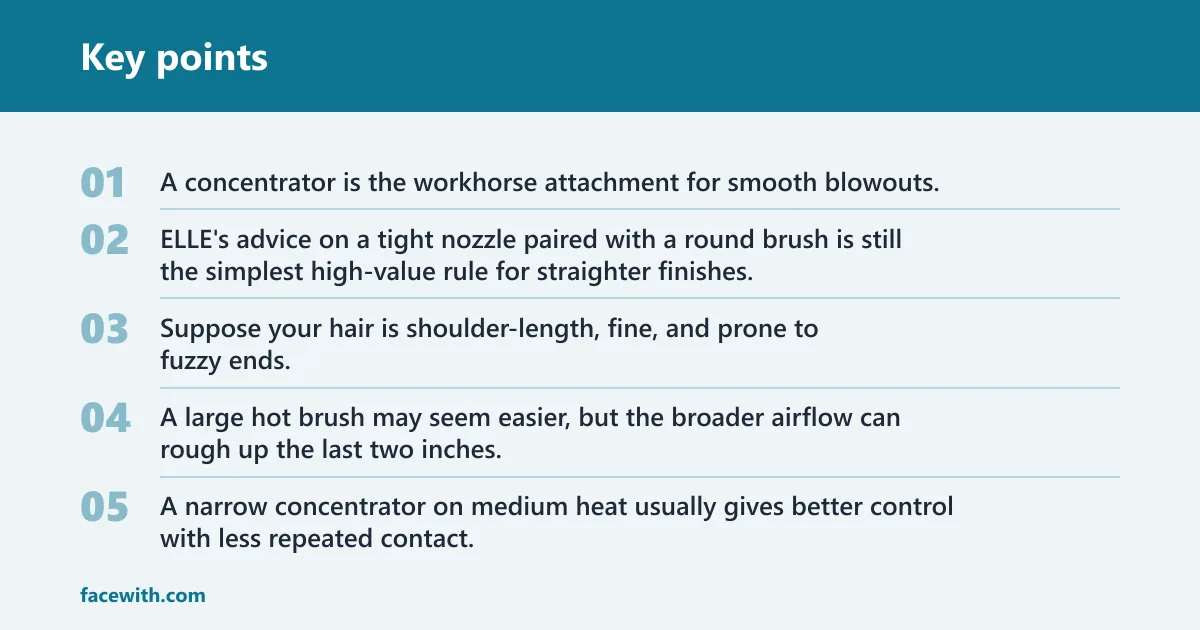
A concentrator is the workhorse attachment for smooth blowouts. It narrows the airstream so you can keep airflow moving from roots to ends instead of blasting sections sideways.
That downward direction matters because frizz often gets worse when the cuticle is pushed open by random airflow. ELLE’s advice on a tight nozzle paired with a round brush is still the simplest high-value rule for straighter finishes.
Suppose your hair is shoulder-length, fine, and prone to fuzzy ends. A large hot brush may seem easier, but the broader airflow can rough up the last two inches. A narrow concentrator on medium heat usually gives better control with less repeated contact.
Heat control systems, ceramic heating, and hot-spot prevention
Ceramic heating spreads heat more evenly across the airflow path, which lowers the risk of one section getting scorched while another is still damp. That evenness is especially useful on fine hair, high-porosity hair, and color-treated lengths.
A good heat control system goes beyond a simple high-low toggle. It regulates temperature so the dryer does not spike hotter as you work more slowly through the ends. That is where damage-conscious shoppers should focus.
Ionic output, static reduction, and smoother-finish claims
Ionic technology is common in midrange and premium dryers because it can reduce static and push hair toward a smoother finish. For many shoppers, especially with medium to thick frizz-prone hair, that is a real advantage.
But ionic is not a universal win. Fine, low-density, or already-flat hair can end up too collapsed at the roots if the dryer also runs very hot and very forcefully. In those cases, ceramic heat plus moderate airflow is often the safer route.
Weight, wattage, and motor speed without the marketing fog
Wattage is a rough power signal, not a complete performance score. A common full-size range is about 1600W to 2200W. A 2200W dryer can move through thick hair faster, but poor nozzle control can still leave the surface puffy.
Motor speed and airflow claims matter because faster drying shortens the time hair sits under heat. ANNLARY, for example, claims 110,000 RPM, 1500W, and 25 m/s airflow. Those figures matter only if heat remains controlled.
Weight affects frizz more than many buyers expect. A heavy dryer encourages awkward angles and repeated passes late in the blowout, when hair is most vulnerable to over-drying. Some premium dryers cut fatigue sharply: Bio Ionic 10X UltraLight is described as weighing less than a pound, and CNET says the Dyson Supersonic r weighs 0.7 lbs.
What actually causes frizz during blow-drying
Blow-drying causes frizz when the hair cuticle is raised, the hair is left too dry or too damp, or the dryer’s airflow roughs up the strands. The supporting article breaks down those three triggers in plain terms so you can identify whether the problem is heat, moisture imbalance, or technique.
That matters because each cause needs a different fix: adjusting distance and airflow, improving drying direction, or changing how much heat you use. If you want a clearer diagnosis before shopping for new tools, hair dryer frizz causes explains what’s happening and how to reduce puffiness without guessing.
Should you buy an ionic or ceramic hair dryer for frizz?
Buy ionic if your hair is medium to thick, takes a long time to dry, or gets static and puffed up during blowouts. Buy ceramic if your hair is fine, damaged, color-treated, or quick to overheat. For mixed needs, a dryer that combines ionic frizz control with even ceramic heat is the safest bet.
When ionic makes sense
Ionic dryers fit dense hair, coarse strands, and long blowouts where dry time itself creates frizz. Less time under airflow often means fewer chances to rough up the cuticle.
They also fit shoppers who want a smoother, less fluffy finish with a concentrator. If that sounds like your routine, start there.
When ceramic makes more sense
Ceramic is the better match when frizz and fragility show up together. Fine hair can look frizzy because it is being overworked, not because it needs more force.
Picture a chin-length bob with color on the ends and frizz mainly at the perimeter. A high-output ionic dryer on high heat may flatten the crown yet leave the ends thirsty. Ceramic heat on medium, finished with cool shot, is more likely to keep shape and shine.
When a dryer with both is the safer buy
Many shoppers sit in the middle: medium density, some color, occasional round-brush blowouts, occasional air-diffused waves. That is where mixed ceramic-and-ionic designs make sense.
Look for separate heat and speed controls, not one preset style mode. Control is what lets you use ionic benefits without forcing every section through the same temperature.
Is a diffuser or concentrator better for frizzy hair?
A concentrator is better when you want smooth, stretched hair with brush tension and a polished surface. A diffuser is better when your waves or curls frizz because brushing breaks the pattern apart. The better tool is the one that matches the finish you actually want, not the one that ships in the box.
Choose a concentrator for smooth blowouts and brush tension
For straightened or softly bent ends, the concentrator wins. It keeps airflow narrow and aimed downward, which helps a round brush create tension without the dryer spraying air across neighboring sections.
A concentrator also beats many brush attachments on fine or damaged hair because it separates heat from tension. You control the brush with one hand and the dryer with the other, instead of forcing the same hot barrel through every pass.
Choose a diffuser for waves and curls that frizz when over-handled
Wavy and curly hair often frizzes more when stretched than when dried in pattern. A diffuser reduces disruption by spreading air over a larger area at lower force.
That is why CNET naming the Dyson Supersonic as best for curly hair matters here. Curl-friendly picks are usually stronger on attachment design and low-disruption drying than classic blowout-first models.
When a brush attachment helps and when it makes frizz worse
Brush attachments help on medium-density hair that wants a bend but does not need maximum root lift or tight section control. They save time when the hair is already partly dry.
They can make frizz worse on fine hair, split ends, and high-porosity lengths because the same pass applies heat, tension, and airflow. If ends fray before roots are dry, switch back to a concentrator and separate brush.
Best options by hair type and routine
Fine frizzy hair
Best pick: Bio Ionic 10X UltraLight. Its 1800W EcoDrive brushless motor lands in the useful full-size range, and the model is described as weighing less than a pound. That combination suits long styling sessions where arm fatigue can lead to too many slow, hot passes.
Why it fits: Fine frizzy hair needs control more than brute force. Pair a light dryer with a concentrator and medium heat, then finish with cool shot.
Pros: Light handling; enough wattage for a real blowout; premium comfort angle.
Cons: Premium pricing; some fine hair may still prefer ceramic-heavy tuning over stronger ionic smoothing if root volume is the goal.
Thick frizzy hair
Best pick: JOHN Professional Ionic Hair Dryer. It is listed at 2200W, which makes sense for dense hair that stays damp too long under weaker dryers.
Why it fits: Thick hair often frizzes because drying takes too long. Stronger output can cut total exposure time, especially with a concentrator and sections that are not too wide.
Pros: High wattage; straightforward fit for dense hair; likely better value than many premium models.
Cons: Power alone does not guarantee smoothness; shoppers still need good heat control and a nozzle that stays secure.
Wavy and curly frizzy hair
Best pick: Dyson Supersonic. CNET names it the best hair dryer for curly hair, which lines up with what wavy and curly shoppers need most: controlled airflow and attachments that preserve pattern instead of scattering it.
Why it fits: If your hair frizzes when brushed out, preserving curl formation often works better than forcing a smooth blowout. Start with the diffuser, then use a concentrator only when the goal is a straighter finish.
Pros: Strong curly-hair reputation; premium attachment ecosystem; good fit for pattern-first drying.
Cons: Premium cost; overkill if you rarely wear your natural texture.
Damaged or color-treated hair
Best pick: Sutra SAMRA. Good Housekeeping says it has 1600W, 6 settings, and a 1.2 lb body. That spec mix points toward control and comfort, both valuable when hair is fragile.
Why it fits: Damaged hair needs enough power to avoid endless drying, but not a single scorching mode. Six settings give more room to match roots, mids, and ends.
Pros: More setting flexibility; lighter than many full-size dryers; damage-conscious fit.
Cons: Lower wattage than thick-hair-focused picks; may feel slower on very dense hair.
Budget frizz control
Best pick: ANNLARY Plasma Ion Hair Dryer. It claims 110,000 RPM, 1500W, and 25 m/s airflow for faster drying, which is a useful budget formula when paired with decent attachments and real temperature control.
Why it fits: Budget buyers usually need speed first, but speed without control can backfire. This type of dryer makes sense if it includes multiple heat levels and a concentrator you will actually use.
Pros: Budget-friendly positioning; strong claimed motor speed; faster-drying pitch without premium pricing.
Cons: Lower wattage than many full-size salon-style dryers; budget attachment quality and filter design can vary more.
Travel use
Best pick: Bio Ionic 10X UltraLight, with a voltage check first. Weight matters on the road, and this model is described as weighing less than a pound. If packability is the main pain point, that is compelling.
Why it fits: Many travel frustrations come from weak hotel dryers that run hot but dry slowly. A light personal dryer can fix that, but international travelers should prioritize dual voltage before anything else.
Pros: Easy to pack; lighter on the wrist; still full-size in power class.
Cons: Light weight does not equal travel-ready voltage; frequent international travel may call for a true dual-voltage model instead.
Are expensive hair dryers worth it for frizzy hair?
Expensive hair dryers are worth it only when they buy something that changes outcomes: lower weight, better temperature regulation, faster motors, stronger attachments, or cleaner airflow control. They are not worth it if the upgrade is mostly styling extras and your hair already responds well to a competent midrange ionic dryer.
What budget models can do well
Budget dryers can reduce frizz if they get the basics right: ionic output, a usable concentrator, at least moderate airflow, and enough control to stay off the hottest setting most of the time.
ANNLARY’s claims show what budget marketing often pushes: high motor speed and faster airflow. That can help, but check maintenance points too. A clogged rear filter lowers airflow and pushes users toward hotter settings.
What midrange usually adds
Midrange is often the sweet spot. This is where buyers usually get better nozzle fit, more stable temperatures, separate heat and speed controls, and less rattly attachment systems.
That matters over time. A wobbly concentrator changes airflow direction, and frizz control depends on precision.
What premium pricing should buy before it is worth the jump
Premium should buy lighter handling, smarter heat regulation, attachment quality, and build details that stay useful after a year of ownership. CNET lists Shark Glam at $400 and names it best for frizzy hair, while the Dyson end of the market also competes on weight and attachment engineering.
If a premium dryer is still heavy, runs only a few settings, or lacks a filter design that is easy to clean, the value case gets weak fast.
How to choose a hair dryer for frizzy hair
Match the dryer to porosity, density, and damage level
- Identify your density. If sections feel bulky and stay wet for a long time, prioritize stronger airflow and often higher wattage. If hair is sparse or fine, move heat control and ceramic evenness above raw power.
- Check your porosity signs. High-porosity hair often drinks up water fast and frizzes as it dries, so choose stable heat and a concentrator or diffuser that limits disruption. Low-porosity hair may need more airflow to move water off the surface without long exposure.
- Rate your damage level. If ends are color-treated, split, or quick to feel rough, use dryers with several settings and a cool shot. Temperature regulation matters more here than chasing the biggest wattage number.
Match attachments to your styling habit
- Choose your finish first. For smooth blowouts, use a concentrator and brush tension. For waves or curls that frizz when brushed, use a diffuser and lower speed.
- Limit brush attachments. Use them when hair is partly dry and medium in density. Skip them if your ends snag, puff, or lose shape before the roots are dry.
- Finish with cool shot. End on cool air once the section is dry and shaped. That helps set the style with less final-pass heat exposure.
Check voltage, filter design, cord length, and long-term upkeep
- Verify the voltage. U.S.-only dryers are fine for domestic use, but international travel calls for dual voltage unless you want converter hassles and performance issues.
- Inspect the filter. Choose a removable rear filter when possible. Lint buildup cuts airflow, and reduced airflow often leads people to overuse heat.
- Check the cord and attachments. A longer cord makes better angles easier, and secure attachments matter because a loose concentrator ruins precision. Durability is ownership value, not a small detail.
A common mistake when shopping for a hair dryer for frizzy hair is choosing the hottest setting options without checking for ionic technology or a diffuser. A 2200W dryer with a poor nozzle and jumpy heat can leave more frizz than a steadier 1800W model that keeps airflow controlled from roots to ends.
Frequently asked questions
What is the best hair dryer for frizzy hair?
For most shoppers, the best hair dryer for frizzy hair is an ionic full-size model with at least 1,800 watts, several heat settings, two speeds, and a concentrator. Shark Ionic SpeedStyle stands out as the broadest recommendation because CNET lists it as the best hair dryer overall.
What features help a hair dryer reduce frizz?
The most useful frizz-control features are a concentrator nozzle, stable heat control, multiple settings, ionic output, and a cool shot button. Fast airflow helps too, because shorter drying time can reduce overexposure, but only when the dryer does not create hot spots or scatter airflow across the section.
What hair dryer is best for thick frizzy hair?
Thick frizzy hair usually does best with stronger airflow, ionic technology, and enough power to shorten dry time. A model like the JOHN Professional Ionic Hair Dryer, listed at 2200W, makes sense here, especially when used with a concentrator and sections small enough to dry evenly.
Can a hair dryer prevent heat damage and frizz?
A hair dryer cannot fully prevent damage or frizz, but the right one can reduce both. Look for temperature regulation, ceramic evenness, several settings, and a cool shot. Those features help dry hair faster and more evenly, which lowers the odds of repeated hot passes on already-dry ends.