Face Massager vs Hands for Anti-Aging Results

Face massagers can beat hands for anti-aging routines when you want repeatable pressure, timed treatment, or easier access to deeper facial contours, but hands still win for control, low cost, and very sensitive skin. Poor technique can irritate skin, worsen redness, or do little beyond temporary puffiness reduction. This guide compares both methods for firmness, circulation, product spread, sensitivity, and practical at-home use.
What facial massage can and cannot do

Facial massage may temporarily plump the skin and make the face look a little better for a short time. The evidence for reversing visible aging is limited, and current studies are small, short, and often rely on appearance ratings rather than hard clinical change.
That means the realistic goal is modest: a brief de-puffed look, a softer surface, and possibly a small circulation change. It is not a replacement for wrinkle procedures, sun protection, or prescription skin care.
Temporary plumping and a better-looking surface
Massage can shift fluid and raise local warmth, which may make skin look smoother for a few hours. That is a visual effect, not proof of long-term tissue change.
People often notice the biggest difference in morning puffiness or after a long day of facial tension. The effect is usually short-lived.
Possible circulation changes, with limited evidence
Clinical evidence for facial massage is limited. A 2018 study used massage rollers on 12 study participants over 5 weeks, and the study found greater vasodilation in only the right cheek. A 2021 pilot study involved six volunteers and CT scans. A 2022 study had five volunteers massage their cheeks for 2 weeks.
Those studies point to possible circulation effects, but they do not settle the question of visible anti-aging benefit. Small participant numbers and short follow-up make it hard to know how much of the effect lasts or who benefits most.
Why the current research is not conclusive
Some lab and human findings are encouraging, but they do not add up to a clear anti-aging verdict. A 2017 lab study found massage increased decorin, fibrillin, tropoelastin, and procollagen-1 expression. A 2017 human study tested 20 white women aged 65–75 years, with 22 others in the comparison group, and after 8 weeks an evaluator rated skin aging and elasticity.
That is useful, but it is still limited evidence. The outcomes were partly subjective, the groups were small, and the design does not prove that massage can reverse visible aging.
Do face massagers work better than hands for anti-aging results?
Sometimes, yes, but only for specific goals. Face massagers can be better when you want consistent pressure, a repeatable routine, or easier work over curved areas like the jawline and cheekbones. Hands still do better when you need immediate pressure changes, low cost, or a softer touch for reactive skin.
Where tools help: even pressure and repeatability
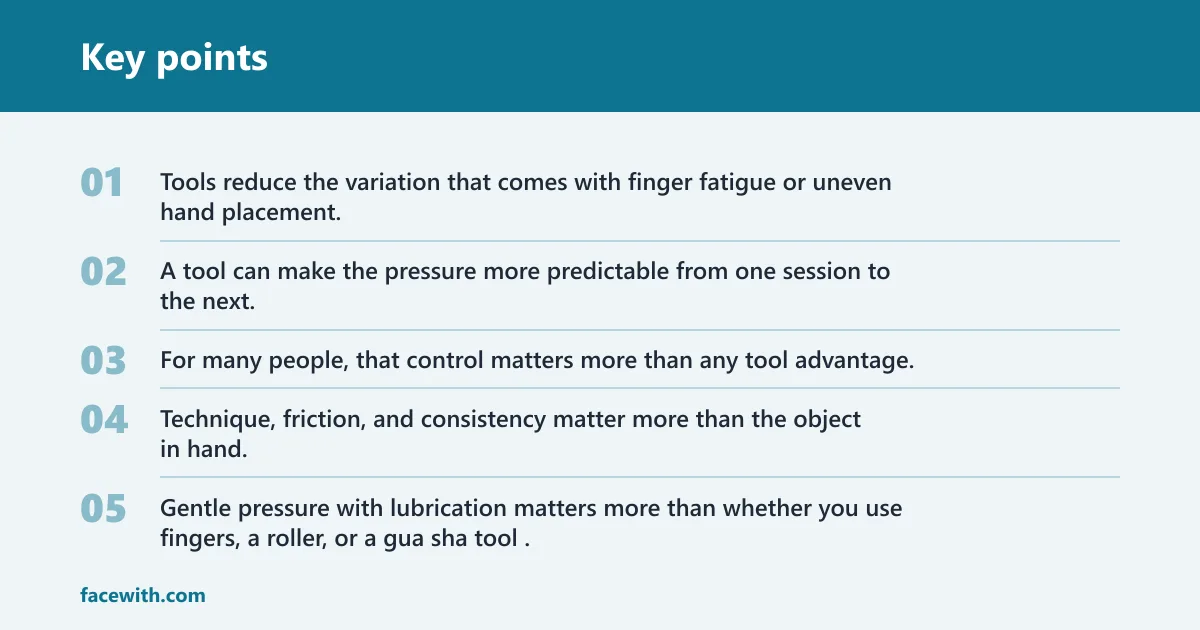
Tools reduce the variation that comes with finger fatigue or uneven hand placement. A face roller can give gentle, even pressure across the skin, which helps if your goal is a calm, steady routine rather than a strongly individualized one.
That consistency matters most for people who tend to press too hard with their fingers or rush through a routine. A tool can make the pressure more predictable from one session to the next.
Where hands still win: control, cost, and fast adjustments
Hands offer direct control. You can shift from the fingers to the thumbs or the heel of the hands, and you can lighten or deepen pressure instantly without changing tools.
Hands also cost nothing extra, clean up quickly, and are easier to use when you want to stop at the first sign of irritation. For many people, that control matters more than any tool advantage.
What matters more than the tool itself
Technique, friction, and consistency matter more than the object in hand. Gentle pressure with lubrication matters more than whether you use fingers, a roller, or a gua sha tool.
Say the goal is to reduce the look of cheek puffiness before an evening event. A roughly 5-minute routine with light pressure and a noncomedogenic oil may be more useful than a harder, longer session with a device that leaves the skin red.
Which method is safer for your skin type?

Safety depends more on skin sensitivity and friction than on the method label. Hands can be gentler because pressure is easier to adjust in real time, but a face massager can also be safe if it is used lightly and cleaned well. For some skin types, the wrong oil or too much pressure causes more trouble than the tool itself.
Sensitive skin and friction control
For sensitive skin, the first priority is lowering friction. Hands, fingers, thumbs, or the heel of the hands should be paired with lotion or oil so the skin is not dragged.
If redness appears easily, manual pressure may be safer because the pressure can be cut back immediately. A rigid tool can be fine, but only if it is used with a very light touch.
Acne-prone skin and noncomedogenic oil choices
People concerned about acne can choose noncomedogenic oils such as jojoba oil. That can reduce pore blockage risk while still lowering friction during massage.
A tool does not automatically make acne-prone skin safer. Dirty rollers, repeated rubbing, or heavy oil can still aggravate breakouts.
Dry or mature skin and comfort during massage
Dry or mature skin often benefits from comfort first. A gentle lubricant can reduce pulling, and a softer manual approach may feel better than a hard-edged tool.
If the skin feels tight or stingy after washing, keep pressure light and skip long sessions. Irritation can cancel out any temporary plumping.
Hands vs Face massager for anti-Aging: Which wins by goal?
| Goal | Best method | Why | Skin-type cautions | When to avoid |
|---|---|---|---|---|
| Puffiness | Face massager or hands | Lymphatic drainage facial massage is often used to reduce puffiness, and a tool can make the pressure more even. | Sensitive skin may prefer lighter manual pressure. | Avoid if the area is inflamed or tender. |
| Sensitivity | Hands | You can adjust pressure instantly and stop at the first sign of discomfort. | Use lotion or oil to reduce friction. | Avoid if rubbing leaves lasting redness or stinging. |
| Acne-prone skin | Hands with noncomedogenic oil | You can choose jojoba oil or another noncomedogenic option and keep contact lighter. | Keep tools very clean if you use them. | Avoid heavy oils and dirty rollers. |
| Quick daily use | Face massager | A roller or device can make a short routine more repeatable. | Fast routines can still irritate if pressure is too firm. | Avoid overusing a device on already irritated skin. |
| Maximum pressure control | Hands | Fingers, thumbs, and the heel of the hands let you fine-tune each pass. | Use lubricant so pressure does not become friction. | Avoid aggressive pressing over active redness or broken skin. |
| Budget-first use | Hands | No extra purchase or maintenance is needed. | Any skin type may need more lubrication. | Avoid if you cannot keep the skin slick enough to prevent drag. |
Which tools count as face massagers?
Face massagers include manual tools and powered devices used at home. The main groups are rollers, gua sha tools, and devices that add motion, vibration, heat, or another mechanical action. Each changes pressure delivery, but none is mandatory for facial massage.
Face rollers and their materials
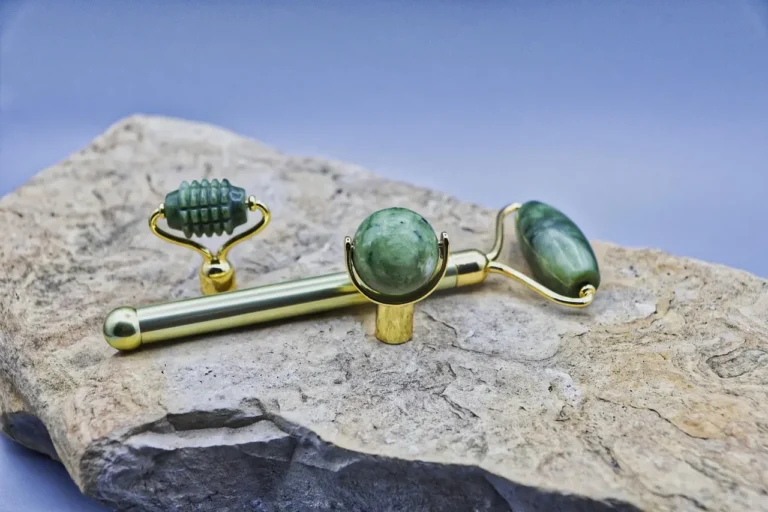
Face rollers are a common gentle option. They apply even pressure and come in metal, wood, glass, and crystal materials.
They suit people who want a simple, low-effort tool for short routines. Their appeal is consistency, not dramatic force.
Gua sha and facial contours
Gua sha uses a flat crystal tool associated with East Asian medicine and shaped to follow facial contours. It can reach along the jawline, cheek, and brow with controlled strokes.
Because the edge is firmer than a roller, pressure control matters more. Too much force can leave skin angry instead of calm.
Powered devices and what they can add
Powered devices may offer vibration, suction, heat, or motorized motion. Those features can improve repeatability, but they can also increase irritation risk if the setting is too strong.
For home use, the main question is whether the added feature changes your routine enough to justify the cost and cleaning burden. If not, hands or a simple roller may be enough.
How to use facial massage at home without irritation
At home, the safest approach is light pressure, enough lubrication, and a short session. Use oil or lotion to reduce friction, keep tools clean, and stop if the skin turns hot, red, or itchy. More pressure is not the goal.
-
Apply a slip layer.
Use lotion or oil before contact so the skin does not drag. If acne is a concern, pick a noncomedogenic oil such as jojoba oil. -
Start with light pressure.
Begin with fingers, thumbs, or the heel of the hands, or use the lightest tool pressure possible. The goal is even contact, not digging into the skin. -
Move with short passes.
Keep strokes brief and controlled rather than repetitive rubbing in one spot. That lowers irritation risk and makes it easier to notice when the skin has had enough. -
Watch the skin response.
Mild warmth is one thing; lingering redness, burning, or soreness is another. Stop if the skin looks more inflamed after the session. -
Clean the tool after use.
Wash rollers, gua sha tools, or device heads after each session according to the material. Clean tools matter more on acne-prone or sensitive skin, where residue can trigger breakouts or irritation.
A common first-timer mistake is pressing harder to chase a “lifting” effect. That usually gives more redness, not better anti-aging results. Another common error is using a tool on dry skin, which turns a gentle routine into friction.
Do dermatologists recommend face massagers or hands for home use?
For home use, the safer default is usually the method you can do gently and consistently. Dermatologists typically care more about avoiding irritation, friction, and overuse than about whether you use a tool or your hands. The best choice is the one that fits your skin and your habits.
If your skin is sensitive, reactive, or acne-prone, hands often make the easiest starting point because pressure can be adjusted instantly. If you want repeatable pressure for a short puffiness routine, a simple roller can make sense.
Frequently asked questions
Are face massagers more effective than manual facial massage?
Not overall. Tools can improve consistency, especially for short home routines, but manual facial massage lets you fine-tune pressure in real time. If your skin is reactive or you need very gentle pressure, manual massage is often the better first choice.
What anti-aging benefits can facial massage actually provide?
The main realistic benefit is a temporary change in how skin looks, often through short-term plumping or reduced puffiness. Small studies also suggest possible circulation changes, but evidence is limited and does not show that facial massage can reliably reverse visible aging.
Is a face massager better than hands for product absorption?
Massage may help spread product across the skin, but that is not the same as proving better absorption. Hands already do this well, and a tool mainly changes how evenly the product is moved. If the skin gets irritated, any absorption gain is not worth it.
Are face massagers safer for sensitive skin than using hands?
Not necessarily. A gentle tool can work well, but hands usually allow faster pressure adjustments, which matters for sensitive skin. The main safety factor is friction control, so lotion or oil and light pressure matter more than the method itself.
Which is better for lymphatic drainage, a face massager or hands?
Either can be used for lymphatic drainage facial massage, which aims to move lymph beneath the skin and is often used to reduce puffiness. Hands offer more direct pressure control, while a tool can make strokes more even. The better choice is the one you can keep gentle.