
Compare LED Face Masks

CurrentBody Skin 2 is the safest default for many shoppers because it pairs a clear 10-minute, three-times-a-week routine with three wavelengths, including 633nm red and 830nm near-infrared. You get defined output and a schedule you can actually follow, instead of a vague beauty claim.
Best LED face mask for most people
What this top pick should do well
For a first mask, the useful questions are simple: does it cover the face well, does it fit without pressure points, and can you keep up with the schedule? A device can have strong specs on paper and still fail if the chin is exposed, the eye area feels awkward, or the routine is too long to repeat.
FDA-cleared wording is a safety signal shoppers should look for at the device level, not a brand-level halo. That matters because two masks from the same company can differ in wavelength mix, LED count, output, and wearability.
Quick picks by skin goal
- Best for wrinkles: CurrentBody Skin 2, because it combines red and near-infrared wavelengths with a short, repeatable schedule.
- Best for acne: Shark CryoGlow, because its Blemish Repair program uses blue, infrared, and red light.
- Best for sensitive skin or redness: A red-light-first mask with a flexible silicone fit and low pressure on the nose and cheeks.
- Best value: The device that gives you the best cost per session after you factor in session length, frequency, warranty, and whether you will actually use it.
Which LED face mask is best for wrinkles?
For wrinkles and fine lines, look first at red and near-infrared wavelengths, because those are the most common choices for collagen-support routines. CurrentBody’s new mask uses 236 bulbs across three light wavelengths, and its red wavelength is 633nm while near-infrared is 830nm.
Red and near-infrared wavelengths to look
Red light is commonly used for anti-aging, and near-infrared is often paired with it in wrinkle-focused masks. Women’s Health says red light is the most popular option for collagen support. The useful comparison is not color alone, though. Check whether the device lists actual nanometer ranges, because that is more specific than a marketing label.
CurrentBody Skin 2 uses a trio of red, near-infrared, and deep near-infrared wavelengths. That mix tells you more than “red light therapy” does, since some devices hide weaker output behind a familiar color name.
Why session length and consistency matter
Wrinkle routines are a consistency game. CurrentBody Skin 2 is listed at 10 minutes, three times a week. Shark CryoGlow’s sessions can be 4 to 15 minutes, 3 to 5 times per week, and the mask recommends one daily program for eight weeks, then maintenance use.
That schedule matters more than one dramatic session. If a mask is uncomfortable, too heavy, or annoying to set up, the real result is skipped sessions, not better skin.
Which LED face mask is best for acne?
For acne and breakouts, blue light is the key wavelength to look for, and it is often paired with red or infrared in multi-mode masks. Women’s Health says blue light targets acne. Shark CryoGlow’s Blemish Repair program uses blue, infrared, and red light, which makes it a more explicit acne-focused option than a red-only mask.
Blue light ranges and common acne use cases
Do not choose by color alone. A blue-light mode can help with active breakouts, but the device still needs enough coverage and a routine you can repeat. If the mask leaves your jawline or chin less covered, acne on those areas may be underserved even if the headline spec looks strong.
Some shoppers also want a device that can shift between acne and maintenance use. In that case, a mask with multiple programs is more practical than a single-purpose unit, because you are not buying a second device later for redness or wrinkle care.
When coverage and fit affect acne routines
Acne routines are especially sensitive to fit. A mask that presses on inflamed areas can feel irritating, and a hard shell may create pressure points along the cheeks or chin. A flexible silicone design usually adapts better to face shape, while a rigid frame can feel steadier but less forgiving.
Suppose someone has breakouts along the jawline and chin but the mask ends above the mouth. That fit gap matters more than a color label, because the acne-prone area is the area that gets skipped.
What is the best mask for sensitive skin?
For sensitive skin or redness, start with a red-light-forward mask that has comfortable eye accommodation and a gentle fit. Red light is usually the safer starting point for skin that reacts easily, while blue light is better reserved for acne-specific use. A mask that feels easy to wear tends to fit into a calmer routine.
Redness, inflammation, and eye comfort
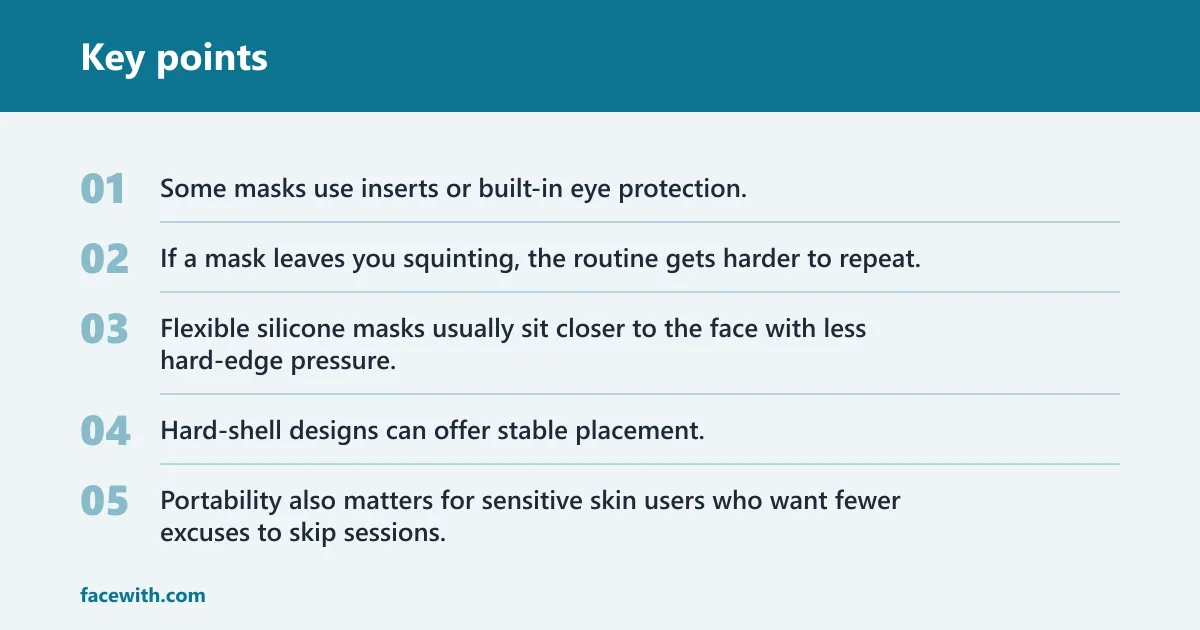
Eye comfort is not a small detail. Some masks use inserts or built-in eye protection; others rely on the user to close the eyes and tolerate bright LEDs. If a mask leaves you squinting, the routine gets harder to repeat, especially when you are trying to use it several times a week.
Flexible silicone masks usually sit closer to the face with less hard-edge pressure. Hard-shell designs can offer stable placement, but they are more likely to create contact points at the bridge of the nose or along the temples.
Silicone fit versus hard-shell pressure points
Portability also matters for sensitive skin users who want fewer excuses to skip sessions. A lighter, foldable silicone mask is easier to store and travel with than a rigid shell. That difference is practical, not cosmetic, because a mask that stays within reach is more likely to be used on schedule.
LED mask comparison matrix
The table below compares devices by spec and routine friction, not hype. Value per use is shown as a simple judgment based on session burden, feature set, and likely repeat use rather than a computed price formula, because prices change and not every seller lists the same accessories or return terms.
| Device | Wavelength mix | LED count | Irradiance | Session length | Weekly frequency | Facial coverage | Eye accommodation | Value per use | Best for |
|---|---|---|---|---|---|---|---|---|---|
| CurrentBody Skin 2 | Red, near-infrared, deep near-infrared; red at 633nm and near-infrared at 830nm | 236 bulbs | Not publicly stated in the supplied specs | 10 minutes | 3 times a week | Face-focused, with better coverage than older 132-bulb version | Depends on fit and light sensitivity; check eye comfort before buying | Strong for repeatable anti-aging use if you want a short routine | Wrinkles and fine lines |
| CurrentBody original | Not fully specified here beyond comparison to the newer model | 132 LED bulbs | Not publicly stated in the supplied specs | Not stated here | Not stated here | Older coverage pattern, less dense than the new mask | Not stated here | Lower than the newer model if you want updated coverage | Budget-minded buyers comparing generations |
| Shark CryoGlow | Blemish Repair: blue, infrared, red; Better Aging: infrared and red | 160 tri-wick LEDs, described as 480 light sources | 73 mW/cm² for red light | 4 to 15 minutes | 3 to 5 times per week; daily program for eight weeks, then maintenance | Broad face coverage with a multi-program layout | Needs good eye tolerance; check whether the insert shape works for your face | Strong if you want acne and aging modes in one mask | Acne plus wrinkle care |
How to compare LED face masks
Compare LED face masks by wavelength mix, LED count, irradiance, fit, and session burden. The color name alone is not enough. A red mask with poor coverage or a routine you skip is a weaker buy than a multi-wavelength mask you will actually wear three to five times a week.

Wavelength mix and nanometer ranges
Start by matching wavelength to the concern. Red is commonly used for wrinkles and collagen support. Blue is the acne-specific option. Near-infrared is often paired with red for anti-aging routines. Look for actual nanometer ranges, such as 633nm and 830nm, instead of vague “multi-light” language.
LED count and coverage
LED count is a coverage clue, not a verdict. CurrentBody’s newer mask uses 236 bulbs, while its original device used 132 LED bulbs. Shark CryoGlow uses 160 tri-wick LEDS, described as 480 light sources. More sources can help spread light more evenly across the face, especially around the cheeks and jawline.
Coverage matters because under-treated zones reduce the usefulness of the whole mask. A face mask that ignores the chin may still be fine for forehead lines, but it is a poor match for lower-face acne or jawline redness.
Irradiance and treatment time
Irradiance, measured in mW/cm², is a useful output spec because it tells you how much light intensity the device delivers to the skin. Shark CryoGlow lists red light irradiance at 73 mW/cm². That number helps you compare output more directly than marketing adjectives do.
Treatment time is the other half of the equation. Short sessions are easier to repeat, but a short session with weak output may not be attractive. The better buy is the one with a sensible balance of output, duration, and schedule.
FDA-cleared wording, price tier, and value per use
FDA-cleared wording is worth checking because it gives a device-level safety signal. It does not mean every mask is equal, and it does not replace a look at wavelengths, output, or fit. That is especially important when a brand sells multiple masks at different price tiers.
Budget masks can look cheaper up front and still cost more in frustration if the fit is awkward. Midrange options often land in the best value zone when they combine a shorter routine with better coverage. Premium models are worth paying for only if the added features match your skin goal and you will use them consistently.
Say your main goal is forehead wrinkles, but you wear glasses and hate pressure near the temples. A silicone mask with better eye accommodation may be the smarter choice even if a rigid shell looks more advanced on paper.
Choose the mask that matches your concern, fits your face, and is realistic to repeat. The best device is not the one with the most colors. It is the one with the right wavelength mix, enough coverage, a comfortable eye area, and a session length you can keep up with week after week.
Use this buyer checklist
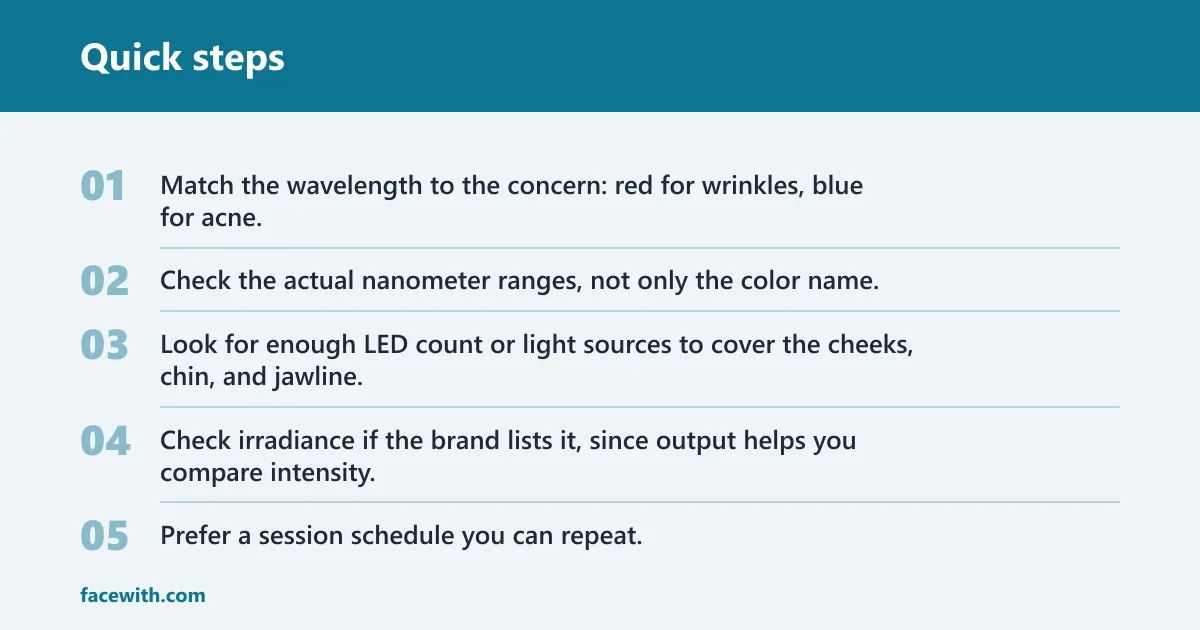
- Match the wavelength to the concern: red for wrinkles, blue for acne, red plus near-infrared for a broader anti-aging routine.
- Check the actual nanometer ranges, not only the color name.
- Look for enough LED count or light sources to cover the cheeks, chin, and jawline.
- Check irradiance if the brand lists it, since output helps you compare intensity.
- Prefer a session schedule you can repeat, such as 10 minutes three times a week or a short daily program.
- Decide whether you need flexible silicone for comfort or a hard-shell design for structure.
- Confirm eye accommodation if you wear glasses or dislike bright light near the eyes.
- Check FDA-cleared wording for the exact device, not just the brand name.
- Compare warranty, accessories, and return policy before you pay for a premium price tier.
What value per use really means
Value per use improves when a mask is easy to wear, short enough to stick with, and specific enough for your goal. A higher sticker price can still be the better buy if it saves you from buying a second device or gives you a routine you will not skip.
It can also fail if the mask is uncomfortable. Poor fit is a hidden cost. So is a program schedule that sounds easy in the product page but becomes annoying in week two.
Frequently asked questions
How do I compare LED face masks?
Compare LED face masks by wavelength mix, LED count, irradiance, fit, and treatment schedule. Then check whether the mask covers the chin and jawline, how the eye area feels, and whether the routine is short enough to repeat three to five times a week without dropping off.
What is the difference between an LED face mask and a laser device?
An LED mask uses light-emitting diodes, while a laser device uses a different light source and delivery pattern. They are not interchangeable. For shoppers, the practical difference is that LED masks usually favor broader, lower-intensity home routines, while lasers are a separate category with different performance and safety considerations.
Do LED face masks actually work?
They can work for some people when the wavelength matches the concern and the device is used consistently. Results are usually gradual, not immediate. A mask that is FDA-cleared, comfortable enough to wear, and used on schedule is far more likely to help than a higher-spec device that stays in the box.
How many minutes should I use an LED face mask?
Follow the device instructions. In the examples here, CurrentBody Skin 2 is listed at 10 minutes, three times a week, while Shark CryoGlow sessions can be 4 to 15 minutes, 3 to 5 times per week. The best session length is the one you can repeat without irritation or skipping.