
Do LED Light Face Masks Work?

At-home LED face masks may help mild acne, redness, and early fine lines, but the gains are usually modest and often take about 8 to 12 weeks of consistent use. Buy the wrong mask or expect clinic-level change, and you waste money and time. This guide breaks down what the evidence supports, what LED masks cannot do, and which skin goals make them worth it.
What LED face masks can realistically do
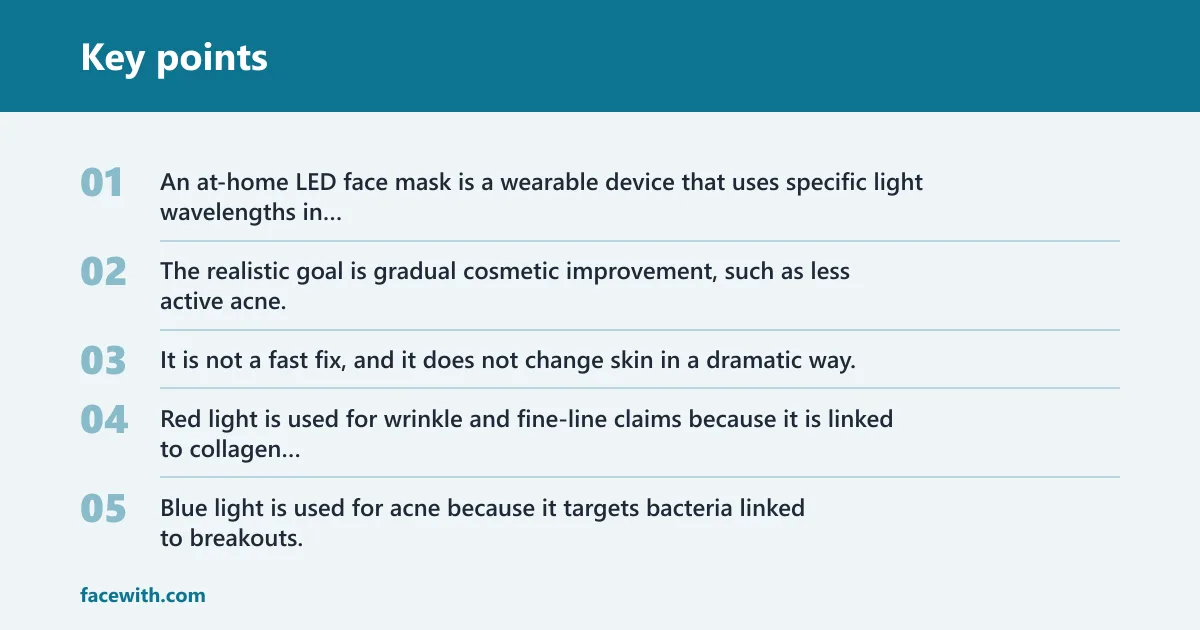
An at-home LED face mask is a wearable device that uses specific light wavelengths in timed sessions. The realistic goal is gradual cosmetic improvement, such as less active acne, a small softening of fine lines, or calmer-looking skin. It is not a fast fix, and it does not change skin in a dramatic way.
How at-home LED masks use wavelength-specific light
Red light is used for wrinkle and fine-line claims because it is linked to collagen stimulation and increased circulation. Blue light is used for acne because it targets bacteria linked to breakouts. Some premium masks add near-infrared light, which is often paired with red light and marketed for skin rejuvenation.
That division matters. A device that is good for acne is not automatically the best pick for wrinkles. Output, fit, and wavelength choice all affect what you get.
Why results usually take weeks, not one session
Most home masks are worn for 10 or 20 minutes per session, and the usual pattern is repeated use over weeks. That is why the strongest claims are about gradual change, not immediate change. If a mask promises visible transformation after a few uses, the claim is too aggressive.
Suppose someone uses a red-light mask for 10 minutes every other day and expects a line at the corner of the eye to disappear in a week. That is the wrong expectation. A more realistic target is a mild softening over about 8 to 12 weeks, if the device is suitable and use is steady.
What cosmetic improvement means in practice
For most people, “working” means a small but visible shift that is easy to miss day by day. A less inflamed breakout pattern, a slightly smoother under-eye area, or less redness after a consistent routine all count as cosmetic improvement. It does not mean a medical cure.
That distinction matters for value. If your goal is a subtle change you can tolerate waiting for, an LED mask may be worth considering. If your goal is strong, fast change, the at-home category is usually the wrong tool.
Which light targets which skin concern?
Red light is the main wavelength tied to wrinkles and fine lines. Blue light has the clearest acne use case. Near-infrared light is usually paired with red light in premium masks, but its benefits are marketed more broadly than the evidence can fully support.
Red light for wrinkles and fine lines
Red light is designed to increase circulation and stimulate collagen. That is why it appears in anti-aging masks and in studies that track wrinkle depth, skin smoothness, or eye-area lines. The evidence is better for small cosmetic gains than for major reversal of older skin changes.
Blue light for acne
Blue light targets bacteria linked to acne, and a research review recommends LED treatment for acne. Blue light may kill acne-causing bacteria, which gives it a clearer mechanism than many other cosmetic light claims. Among home LED uses, acne is the most defensible buy case.
Near-infrared light in premium masks
Near-infrared light is often bundled with red light in higher-priced devices and sold as a skin rejuvenation feature. That pairing is common, but the extra marketing should not be confused with stronger proof. It may be useful, but it does not automatically turn a home mask into an in-office device.
LED mask decision table
This table maps the main goals to the likely payoff. The recommendation is based on how strong the evidence is, how long results usually take, and how much change a home device is likely to deliver.
| Skin goal | Expected benefit | Best wavelength | Realistic timeline | Worth it? |
|---|---|---|---|---|
| Wrinkles | Modest softening of fine lines; small cosmetic change | Red, often paired with near-infrared | About 8 to 12 weeks of repeated use | Worth it if you want gradual, mild improvement |
| Acne | Best-supported home use; may reduce breakouts | Blue | Several weeks of consistent sessions | Worth it for mild to moderate acne patterns |
| Redness | Possible calming effect, but less certain than acne | Red, sometimes with near-infrared | Several weeks | Maybe worth it if redness is mild and cosmetic |
| Eye-area lines | Some improvement is plausible; gains are limited | Red | About 12 weeks in wrinkle studies | Worth it only for modest expectations |
| Maintenance | Possible upkeep tool after other improvements | Depends on your goal | Ongoing use | Worth it for routine users, not one-off fix seekers |
Do LED face masks work for wrinkles?
Sometimes, but the effect is usually modest. Red-light studies can show small wrinkle improvements, and one study with 52 female participants found red LED improved eye-area wrinkles at 12 weeks. That is encouraging, but it is not the same as dramatic tightening or a filler-like result.
What wrinkle studies usually measure
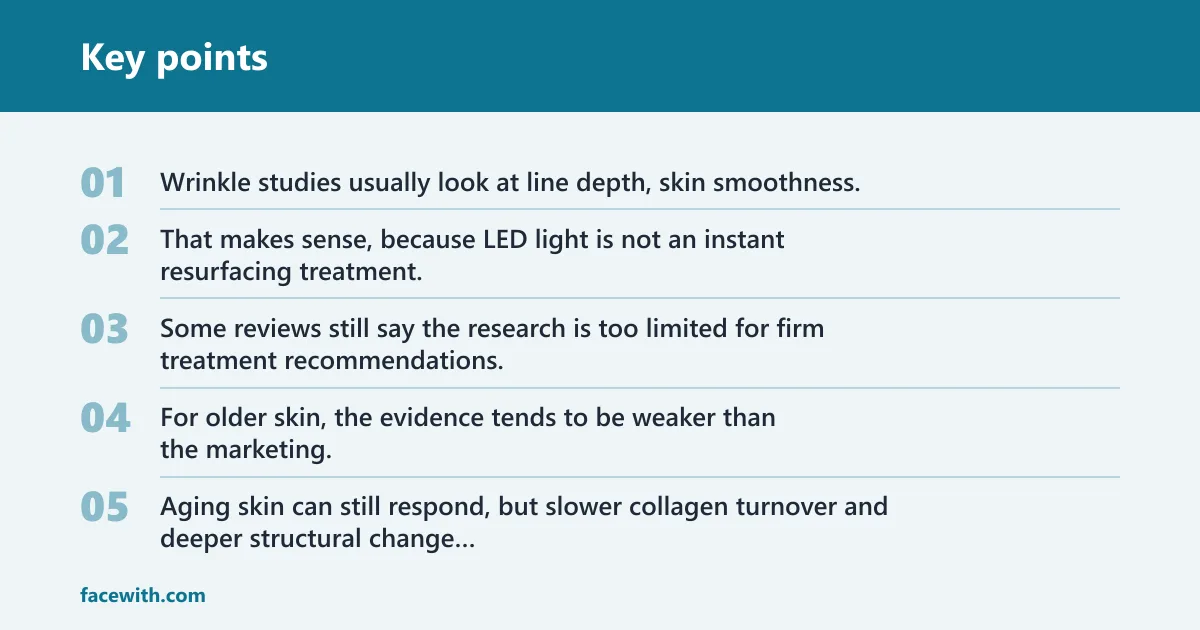
Wrinkle studies usually look at line depth, skin smoothness, or visible change after repeated sessions. That makes sense, because LED light is not an instant resurfacing treatment. Some reviews still say the research is too limited for firm treatment recommendations, which is why the claims stay cautious.
How strong the evidence is for older skin
For older skin, the evidence tends to be weaker than the marketing. Aging skin can still respond, but slower collagen turnover and deeper structural change make big results less likely. LED masks may help surface-level signs, yet they do not replace procedures designed for stronger remodeling.
Picture a 62-year-old using a red-and-near-infrared mask for 20 minutes a session. If the goal is a slight softening around the eyes, that is plausible. If the goal is to erase deeper forehead lines, a home mask is unlikely to be enough.
When a wrinkle claim is worth paying
A wrinkle claim is worth paying for only if you want a mild, low-effort routine and can wait for weeks. It is less compelling if you want a fast turnaround, major lifting, or a more visible change on its own. In that case, the value drops quickly.
Do LED face masks work for acne and redness?
Acne is the clearest use case. Blue light targets bacteria linked to acne, and a research review recommends LED treatment for acne. Redness is a weaker claim than acne, though some people do see a calmer look when red light is used consistently over time.
Why blue light has the clearest use case
Blue light has the simplest logic: it targets the bacteria involved in acne, and that gives it a direct role in home treatment. For mild to moderate breakouts, it is the part of LED therapy most likely to deliver visible benefit. It is still gradual, not instant.
Where redness claims are weaker than acne claims
Redness is harder to measure and easier to overpromise. A mask may make skin look less irritated, but that is different from treating a medical redness disorder. If your concern is occasional flushing or post-breakout redness, a red-light mask may help a little; if it is persistent redness, the result is less certain.
Who is most likely to notice a change?
People with mild to moderate acne, or people whose redness is mainly cosmetic, are most likely to notice a difference. Someone with severe acne, rosacea, or scarring should not expect the same payoff. LED masks are closer to a support tool than a stand-alone solution.
Safety, fit, and buying tradeoffs
LED masks have an excellent safety profile when used as directed, but that does not mean every device performs well. Eye protection matters, fit matters, and output strength varies. A mask can be safe and still be too weak to matter much.
Eye protection and proper use
Because these devices sit close to the face, the eyes need protection or at least careful shielding according to the product instructions. Do not use a mask longer than directed, and do not ignore warnings about sensitive skin, photosensitizing products, or broken skin. Safe use and effective use are related, but not identical.
How flexible silicone and fit affect performance
Some masks use medical-grade silicone, which helps with flexibility and comfort. A better fit can reduce light leakage and improve contact with the skin. If the mask gaps at the nose, cheeks, or jaw, the treatment is less even and the result may be weaker.
Price range, session length, and value
Home devices often cost $100 to $500, and premium masks can sit around £299 / $349. Higher price does not guarantee better output. For example, the HigherDOSE mask uses red and near-infrared wavelengths, offers 10 or 20 minute treatments, and has a medical-grade silicone outer case, but its value still depends on whether those features match your goal.
A simple value check helps: divide the price by the number of sessions you expect to use it. A $349 mask used three times a week for 12 weeks works out to about 36 sessions, or about $9.70 per session. If you keep using it beyond that, the cost per session falls.
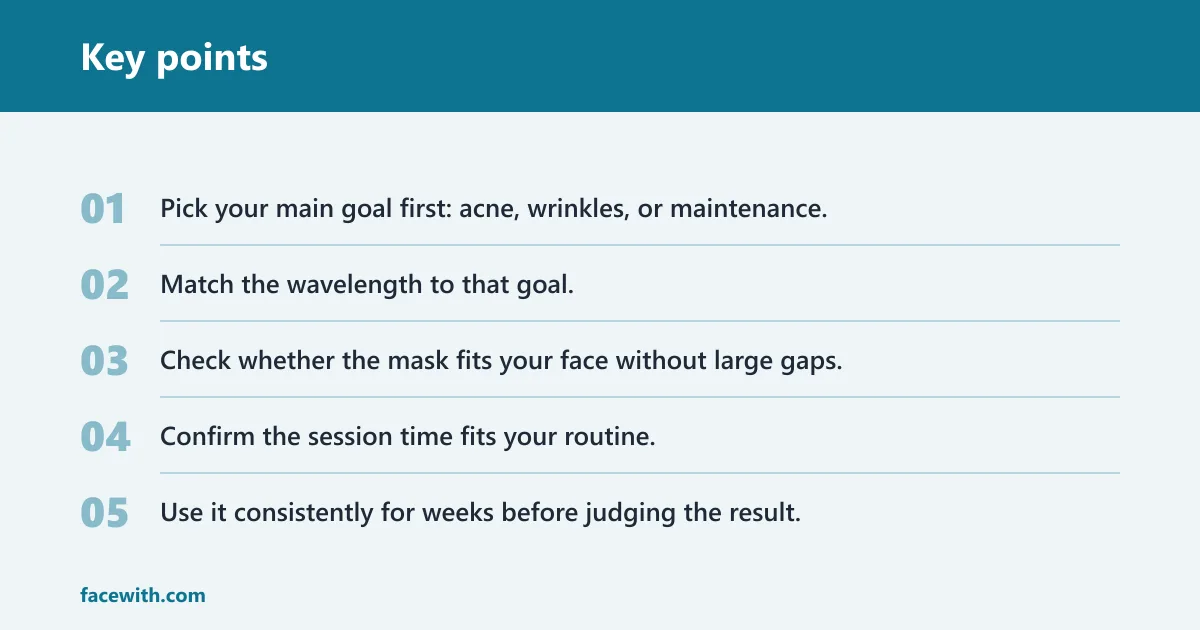
- Pick your main goal first: acne, wrinkles, or maintenance.
- Match the wavelength to that goal.
- Check whether the mask fits your face without large gaps.
- Confirm the session time fits your routine.
- Use it consistently for weeks before judging the result.
A common first-timer mistake is buying a premium mask for eye-area lines, then using it twice a week for a month and calling it a miss. That is too little time to judge the device fairly. Another mistake is buying blue light for acne and expecting the same payoff for deep wrinkles.
Frequently asked questions
Do LED light face masks work?
Yes, but only for specific goals and with modest expectations. The strongest home use case is acne, while wrinkle and redness results are usually smaller and slower. Consistent use for 8 to 12 weeks matters more than the brand name on the mask.
Do LED light therapy face masks work?
They can work as a home cosmetic tool, especially when the wavelength matches the concern. Blue light has the clearest acne role, and red light has the main wrinkle role. The devices are useful for gradual improvement, not for quick or dramatic change.
Do LED red light face masks work?
Red light can help fine lines and some eye-area wrinkles, but the effect is usually mild. One study with 52 female participants found improvement at 12 weeks. That is a real signal, though still far from the kind of change seen with stronger in-office treatments.
Do LED face masks work for eye bags?
Not reliably. Eye bags often come from puffiness, fat shift, genetics, or fluid retention, and LED light does not directly fix those causes. A red-light mask may slightly soften fine lines near the eyes, but it is a weak answer for true under-eye bags.
Do LED face masks work for older skin?
They may help older skin a little, especially with fine lines or a dull look, but the results are usually subtle. Older skin tends to need more time and may show less change. If the goal is major tightening or deep wrinkle correction, the device is unlikely to satisfy.
Do LED face masks work for acne?
Yes, acne is the best-supported home use case. Blue light targets bacteria linked to acne, and a review recommends LED treatment for acne. The benefit is most likely with mild to moderate breakouts and consistent use over several weeks, not with one-off sessions.