
Does the Material of a Gua Sha Tool Affect Results?

Yes: material changes glide, cooling, edge shape, and breakage risk, but it does not change the skin biological response nearly as much as technique, pressure, and consistency do. Choose poorly and you may get more irritation, scratches, or a tool you stop using. This guide separates what material changes physically, what it cannot change biologically, and how to pick the safest tool for your skin and routine.
What different materials change and what they do not
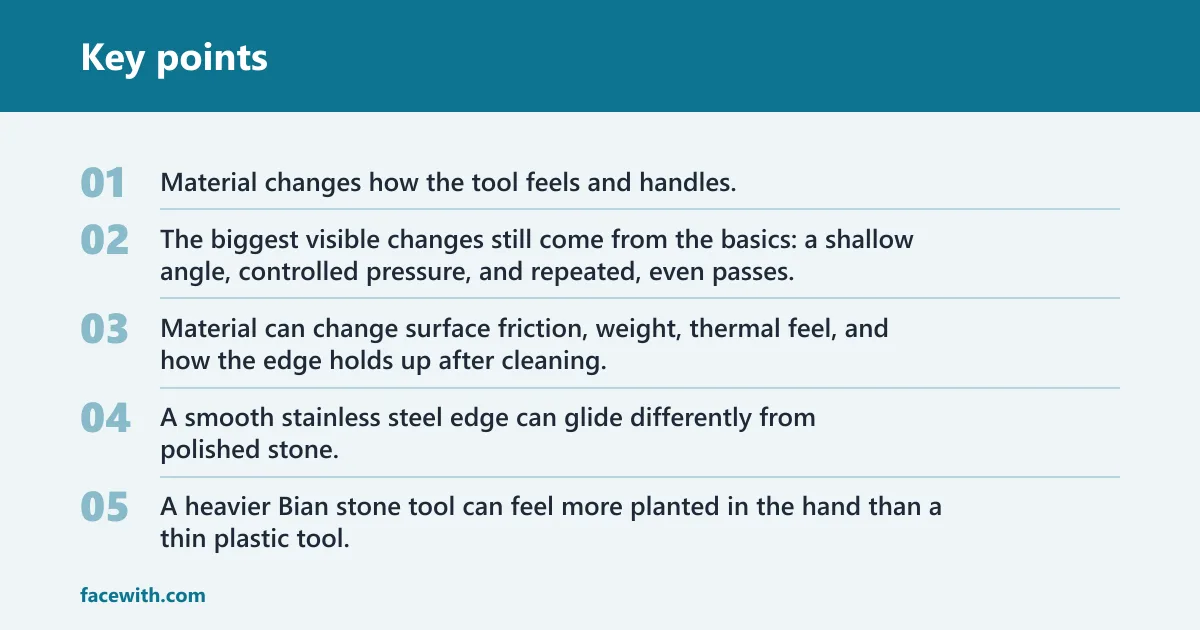
Material changes how the tool feels and handles. It can change slip on oiled skin, how cold the tool feels, how easy it is to clean, and how likely the edges are to stay smooth over time. It does not turn one tool into a different treatment.
The biggest visible changes still come from the basics: a shallow angle, controlled pressure, and repeated, even passes. The ELLE guide recommends a 15-45 degree angle, and it also notes that gua sha can cause an at least fourfold increase in microcirculation. That is a handling effect, not proof that one material drains more fluid than another.
What material can change
Material can change surface friction, weight, thermal feel, and how the edge holds up after cleaning. A smooth stainless steel edge can glide differently from polished stone. A heavier Bian stone tool can feel more planted in the hand than a thin plastic tool.
It can also affect sanitation. Stainless steel is non-porous, so residue is easier to remove. Stone and horn depend more on finish quality, because surface pores, microfractures, and small chips can trap product or irritate skin.
What material cannot change
Material does not create a separate biological pathway for lifting, detoxing, or reshaping the face. It does not override pressure, angle, or routine. If the stroke is too hard or too fast, the skin will respond to that force, whatever the tool is made from.
That is why the most commercially motivated claims tend to center material, while practical performance usually comes down to technique. A tool can feel luxurious and still be poorly finished.
Why technique still matters more
Technique is the main driver of comfort and visible short-term change. Use a non-comedogenic, lightweight oil such as squalane, keep the tool moving in smooth passes, and stay light around the under-eye and cheek area. More pressure is only appropriate where skin is sturdier, such as the jawline or forehead.
A heavy stainless-steel gua sha can leave the skin flushed before any benefit shows up, especially if too much pressure is used because it feels more “professional.”
Gua sha material comparison matrix
This matrix ranks common materials by practical use, not by marketing language. The ranking is about typical performance when the tool is well made. A poor edge can make any category worse.
| Material | Slip | Cooling | Durability | Hygiene | Reactive-skin friendliness | Best for | Avoid if |
|---|---|---|---|---|---|---|---|
| Jade | Good when polished well | Medium-cool | Moderate; can chip | Moderate; clean carefully | Good if edges are rounded | People who want a classic stone feel and a moderate price point; Xiuyan jade is often described as “the best affordable Gua Sha tool,” is said to be “one of China’s four famous jades,” and can range from “light green to deep green” | Edges feel sharp, surface shows lines, or the stone seems brittle |
| Rose quartz | Good | Medium-cool | Moderate | Moderate; avoid harsh handling | Good if polished smoothly | People who want a familiar stone with a soft hand feel and gift-friendly look | You want the most sanitary option or the tool shows tiny pits or edge nicks |
| Stainless steel | Very good | High | High | High; non-porous | Very good if the edge is rounded | People who want easy sanitation, strong durability, and a colder feel; many manufacturer pages describe it as non-porous with excellent cooling retention | You are sensitive to heavy weight or the edge is too crisp on thin skin |
| Bian stone | Good when well finished | Medium | Moderate | Moderate | Good only if polished evenly | People who want a heavier-feeling stone and a traditional therapy presentation | You want the easiest clean-up or the tool has a rough finish |
| Buffalo horn | Fair to good | Low to medium | Moderate | Lower than metal; needs careful drying | Can be good, but varies by finish | People who want a traditional material with a different hand feel | You need simple sanitation, frequent alcohol wiping, or very low-maintenance care |
| Plastic or resin | Variable; often lower | Low | Variable; may scratch | Moderate to low | Poor to fair, depending on finish | Budget buying when the surface is smooth and the shape is predictable | The tool flexes, feels rough, or the edge looks uneven |
How to read the matrix
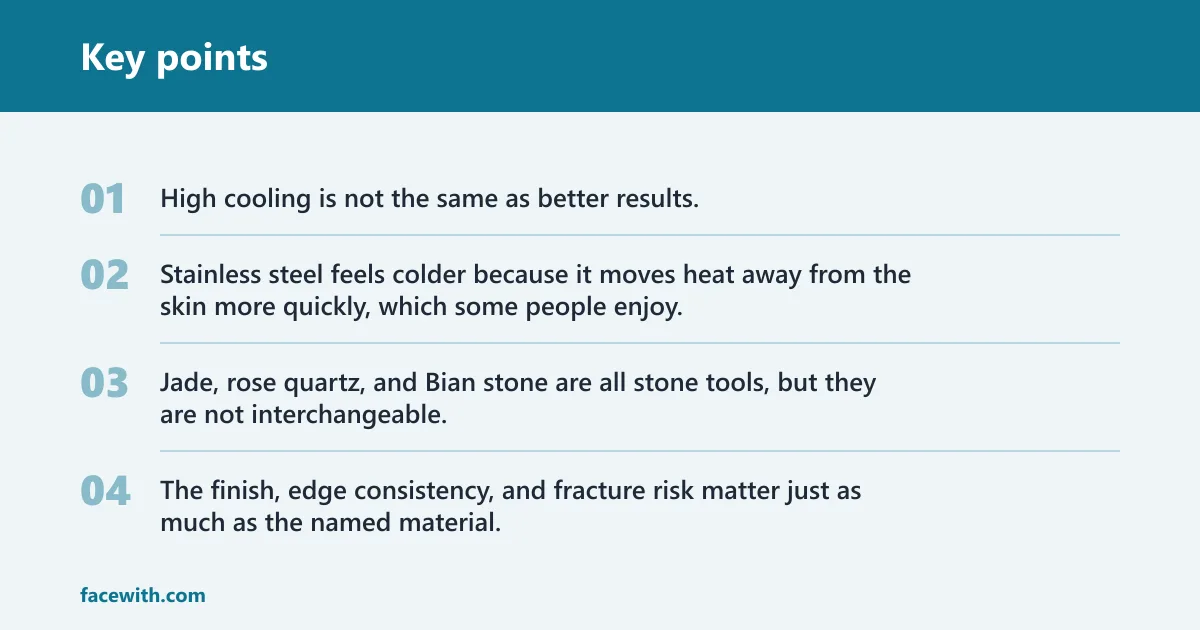
High cooling is not the same as better results. Stainless steel feels colder because it moves heat away from the skin more quickly, which some people enjoy. That sensation can make the stroke feel stronger, even when the pressure is unchanged.
Jade, rose quartz, and Bian stone are all stone tools, but they are not interchangeable. The finish, edge consistency, and fracture risk matter just as much as the named material.
How jade, rose quartz, and Bian stone differ
These three are often grouped together, but they differ in appearance, feel, and maintenance. Jade is often marketed as an affordable stone option, rose quartz is popular for gifting and social media, and Bian stone is often positioned in holistic brands. None of those labels guarantee better performance.
Jade
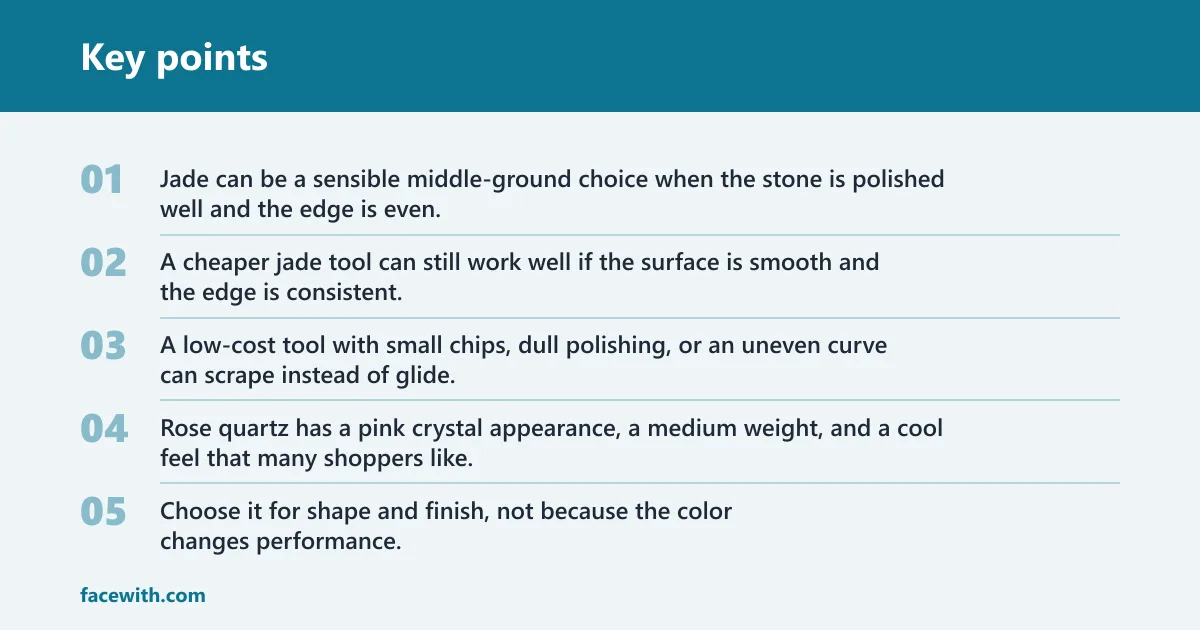
Jade can be a sensible middle-ground choice when the stone is polished well and the edge is even. Xiuyan jade is commonly described as budget-friendly, and some wholesale material pages specifically call it “Budget-friendly lines, large volume projects.” That speaks to positioning, not to a unique skin outcome.
A cheaper jade tool can still work well if the surface is smooth and the edge is consistent. The problem is not price alone. A low-cost tool with small chips, dull polishing, or an uneven curve can scrape instead of glide.
Rose quartz
Rose quartz has a pink crystal appearance, a medium weight, and a cool feel that many shoppers like. It is often chosen because it looks familiar and giftable. That visual appeal can help with routine use, but it does not make the tool more effective on the skin.
Choose it for shape and finish, not because the color changes performance. If the curve catches oil or the edge feels gritty, skip it.
Bian stone
Bian stone is usually darker and heavier in the hand. Some brands frame that weight as part of the experience, but the more useful question is whether the tool is smooth, balanced, and easy to clean.
If the finish is uneven, the extra heft can work against sensitive skin. A heavier tool can make overpressure easier if you are not careful.
Are stainless steel gua sha tools better than stone?
Stainless steel is often better for sanitation, durability, and edge consistency, but not automatically better for comfort. Stone can feel gentler and warmer in use, while metal feels colder and more rigid. The better choice depends on your skin, your cleaning habits, and whether you prefer a firmer glide.
Slip and glide
Steel usually glides very smoothly when paired with enough oil. It keeps its shape well, so a well-made edge can feel predictable stroke after stroke. Stone can also glide well, but it depends more on polish quality and the absence of tiny chips.
Cooling and weight
Many users like the colder feel of stainless steel. That is a sensation, not a result by itself. Steel is also heavier than many stone or resin tools, which can help or hurt depending on your pressure control.
Stone tools vary. Rose quartz and jade can feel cool, while Bian stone often feels heavier. If you tend to press too hard, a heavier tool can amplify that habit.
Hygiene and durability
Metal is easier to sanitize because it is non-porous. A soap-and-water wash followed by a 70% isopropyl alcohol wipe is a straightforward cleaning approach for stainless steel, and UV sterilization is generally more practical for metal than for porous stone. Stone tools cannot undergo autoclave sterilization at 121°C, so heat-based sterilization is not a simple option.
The downside of stainless steel is not hygiene. It is comfort. 304 stainless steel has 8–10.5% nickel content, so very nickel-sensitive users should be cautious.
What about buffalo horn and plastic tools?
Buffalo horn and plastic can work, but they come with more variability. Horn has a different maintenance profile from stone or metal. Plastic and resin can be fine when made well, yet lower-grade versions are more likely to flex, scratch, or wear unevenly at the edge.
Buffalo horn
Horn is a natural material with a traditional look and feel. It can be comfortable when polished well, but it needs gentler cleaning and careful drying. If the finish is rough or the tool is stored wet, the surface can degrade faster than steel.
Choose horn if you like the hand feel and are willing to maintain it. Avoid it if you want the easiest sanitation routine.
Plastic and resin
Plastic and resin tools are usually the budget option. Some are fine for casual use, but finish quality varies a lot. The main risk is not the label. It is a rough edge, a warped curve, or a glossy coating that scratches with use.
These tools can be acceptable if the edge is rounded, the surface is smooth, and the material does not flex under light pressure. If any of those fail, move on.
When lower-cost tools are fine
Lower cost is not the problem. Poor geometry is. A cheaper jade or resin tool can still perform well if the curve matches your face, the polish is even, and the edge is soft to the touch. That is more important than a luxury label.
How to spot a safe, well-made tool
Surface quality matters as much as the material itself. A tool with a smooth finish and rounded edges is easier to use, easier to clean, and less likely to irritate barrier-compromised or reactive skin. Microfractures, pits, and sharp transitions are warning signs.
-
Check the edge first. Run a fingertip along the rim and curve. You want a rounded, even edge with no sharp spots or tiny catches, because the skin will feel those defects before it benefits from the stroke.
-
Inspect the surface under light. Look for dull patches, hairline cracks, pits, and cloudy areas that may signal poor polishing or a fracture point. Those flaws can trap residue and increase irritation risk.
-
Test the weight and balance. The tool should feel steady, not awkwardly top-heavy. If it tips into the skin, it may encourage too much pressure in one spot.
-
Match the finish to your skin. If your skin is reactive, choose the smoothest possible surface with the simplest geometry. Flat, crisp angles and rough carving are the wrong match for easily flushed skin.
Picture a 2.5-inch jade tool with a small nick near one corner. On normal skin, that nick may be only a comfort issue. On skin that is already dry, retinoid-stressed, or freshly exfoliated, it can turn into a red track after a few passes.
How should you clean a gua sha tool?
Cleaning should be simple, repeatable, and matched to the material. For most tools, soap and water after each use is the baseline. Alcohol wipes can help, but not every material tolerates the same routine. Heat and UV are not universal fixes.
-
Wash after each use. Use mild soap and warm water, then dry fully with a clean towel. This removes oil, skin debris, and product residue before it hardens on the surface.
-
Use alcohol on metal. Wipe stainless steel with 70% isopropyl alcohol when you want a stronger sanitation step. Let it air-dry completely before storage.
-
Handle stone more gently. Clean jade, rose quartz, and Bian stone with soap and water rather than aggressive soaking or heat. Stone can be cleaned well, but it is not a candidate for autoclave sterilization at 121°C.
-
Dry horn and resin fully. Do not leave buffalo horn wet, and do not assume every resin is alcohol-safe. Drying prevents surface damage and keeps the edge in better shape.
-
Use UV only as a supplement. UV sterilization may help on some tools, but it does not replace physical cleaning. It also does less for residue in pits, seams, or scratches.
If you share a tool between users or use it on skin that is broken or inflamed, cleaning matters even more. A clean surface does not fix a poor edge, but a dirty one can make even a good edge worse.
Does gua sha material affect results?
Material affects feel, cleaning, durability, and irritation risk more than it affects biological results. In practice, a smooth, well-shaped tool in any sensible material will usually outperform a premium-looking tool with a bad edge. Technique remains the main driver of what you see and feel.
Frequently asked questions
Is jade better than rose quartz for gua sha?
Not by default. Jade and rose quartz are both stone tools, so the deciding factors are edge smoothness, polish, and how comfortably the tool moves on oiled skin. Jade is often positioned as affordable, while rose quartz is often chosen for appearance and gifting.
Does gua sha material matter more than technique?
No. Technique matters more for the outcome most people want from gua sha. A shallow 15-45 degree angle, light pressure, and steady passes matter more than whether the tool is jade, quartz, or steel. Material mainly changes feel and handling.
Which gua sha material is safest for sensitive skin?
Usually the safest choice is the smoothest, most consistently finished tool, not one single material. Stainless steel is easy to clean, but it can feel intense. A well-polished jade or rose quartz tool with rounded edges is often a good fit if your skin is reactive.
Do different gua sha materials feel different on the skin?
Yes. Stainless steel usually feels colder and heavier. Stone often feels cool but less metallic, and horn tends to feel warmer and more organic in the hand. Those differences change comfort and pressure perception, but they do not prove one material gives better skin results.
Can fake or low-quality materials affect gua sha performance?
Yes. A low-quality tool can have rough edges, poor balance, microfractures, or a surface that scratches with use. That hurts glide and raises irritation risk. If the finish looks cloudy, the edge feels sharp, or the material seems brittle, do not buy it.