Gua Sha Tool Materials: Types, Pros, Cons and How to Choose

Choose gua sha material by four factors: skin sensitivity, cleaning needs, breakage risk, and where you’ll use it; for most people, nonporous stainless steel is the safest all-around pick, while smooth stone works if you want a gentler feel. Pick badly and you may end up with a tool that chips, holds residue, irritates reactive skin, or asks for more upkeep than you’ll realistically do. This guide compares common gua sha materials, their pros and cons, and which ones make sense for face, body, scalp, sensitive skin, and professional settings.
The core trade-off
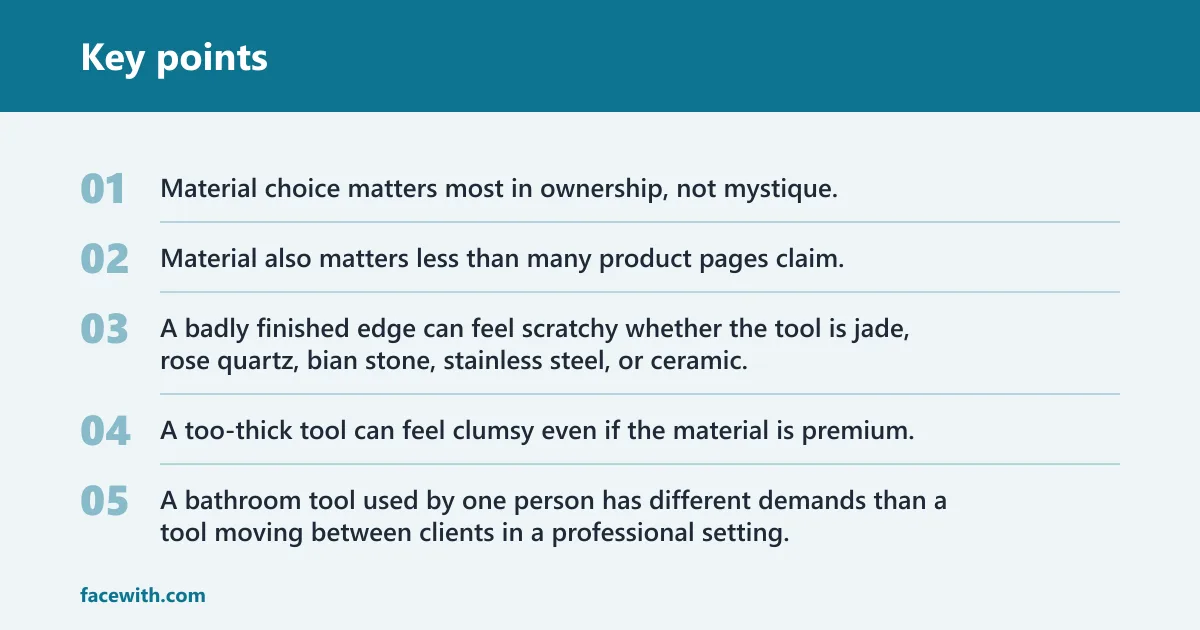
Material choice matters most in ownership, not mystique. The practical questions are straightforward: how cool the tool feels at first touch, how well it survives drops, how easily it sheds oil or balm during washing, whether a specific tool is manufacturer-cleared for stricter reprocessing, and whether the edges stay smooth over time.
Material also matters less than many product pages claim. A badly finished edge can feel scratchy whether the tool is jade, rose quartz, bian stone, stainless steel, or ceramic. A too-thick tool can feel clumsy even if the material is premium. The actual cut and shape decide whether a tool sits flat along the jaw, reaches the sides of the neck, parts through scalp hair, or covers larger body areas without awkward angles.
Gua sha comes from traditional Chinese medicine, where the practice historically involved scraping the skin with a smooth-edged tool. In modern skin-care use, most shoppers are buying a massage tool for glide, pressure, and temporary cosmetic effects such as a cooled, soothed feel, not a material-specific medical result.
Where material matters most
Use-case changes the answer. A bathroom tool used by one person has different demands than a tool moving between clients in a professional setting. A scalp tool needs different geometry than a facial tool. A person with metal sensitivity shops differently from someone mainly worried about breakage.
Where material matters less than build quality
Smoother, consistently finished edges matter more for comfort than a stone’s reputation alone. Symmetry matters too: if one side is thicker or sharper than the other, pressure feels uneven. Surface defects matter more than broad claims about stone structure; chips, cracks, filler lines, and rough polishing are the red flags that change day-to-day use.
Material decision matrix
This matrix uses a simple 1 to 5 scale, where 5 is the most favorable for that buyer criterion and 1 is the least favorable. “Cleanability” means how easily you can remove oil and residue with routine washing. “Sterilization compatibility” is separate: it asks only whether a material may be a more practical fit when a manufacturer specifically supports stricter reprocessing for that tool, not whether base material alone makes any gua sha tool suitable for true sterilization.
| Material | Cooling feel | Durability | Cleanability | Sterilization compatibility | Sensitivity risk | Fragility | Maintenance | Best for |
|---|---|---|---|---|---|---|---|---|
| Jade | 4/5 | 4/5 | 3/5 | 2/5 | 4/5 | 3/5 | 3/5 | Face, buyers who want a traditional stone feel |
| Rose quartz | 3/5 | 3/5 | 3/5 | 2/5 | 4/5 | 2/5 | 3/5 | Face, gentle glide, gift buying |
| Bian stone | 3/5 | 3/5 | 3/5 | 2/5 | 4/5 | 2/5 | 3/5 | Traditional-material shoppers, face or body |
| Stainless steel | 5/5 | 5/5 | 5/5 | 5/5 | 3/5 | 5/5 | 5/5 | Clinic use, body, scalp, easy-care buyers |
| Ceramic | 3/5 | 2/5 | 4/5 | 2/5 | 4/5 | 2/5 | 4/5 | Face, buyers who want a smooth easy-care surface |
How the scoring works
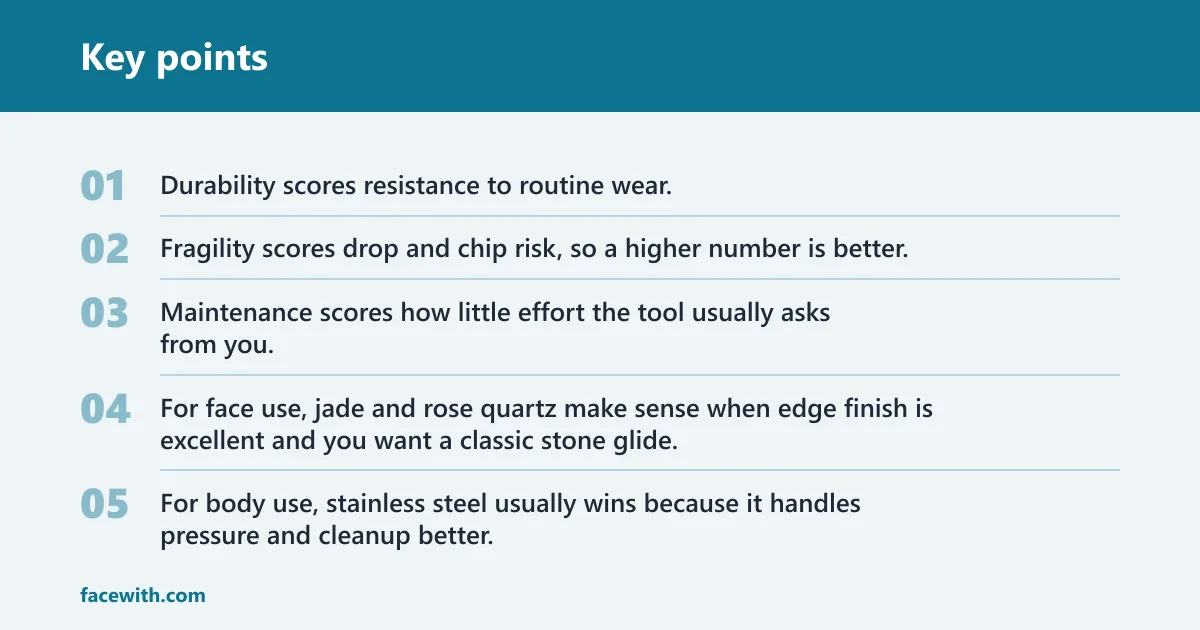
Cooling feel scores the first-touch cool sensation and how likely the material is to feel cool in ordinary room conditions. Durability scores resistance to routine wear. Fragility scores drop and chip risk, so a higher number is better. Maintenance scores how little effort the tool usually asks from you. The matrix is a rough shopping tool, not a lab test, a weighted standard, or proof that one score applies equally to every tool sold in that material.
Best use-case picks
For face use, jade and rose quartz make sense when edge finish is excellent and you want a classic stone glide. For body use, stainless steel usually wins because it handles pressure and cleanup better. For scalp use, shape leads the decision, and steel works well there because the teeth are less likely to chip. For clinic or shared use, stainless steel is the clear practical pick because it is durable and easy to clean, and some tools are sold with specific alloy details rather than vague “medical-grade” or “premium” language.
What material is best for a gua sha tool?
For most shoppers, stainless steel is often the best all-around gua sha material because it combines durability, easy cleaning, and a better fit for settings where stricter reprocessing may matter if the specific tool is designed and documented for it. Jade, ceramic, and rose quartz can also suit buyers who care more about glide and feel than drop resistance.
Best all-around for easy care
Stainless steel is durable and easy to clean. It also avoids the main ownership problem with stone: accidental breakage at the sink. If your routine includes oils, thicker balms, or shared household use, steel asks the least from you after each session.
Medical-grade stainless steel is used in premium tools, but those labels alone should not end the search. Buyers with metal sensitivity should confirm the stated alloy or grade in the manufacturer listing, because stainless formulas vary and some include nickel.
Best for a traditional stone feel
Jade is the most traditional gua sha material. If the appeal is a classic stone tool category with a cool touch and solid day-to-day toughness, jade is a sensible traditional starting point.
Best for buyers prioritizing break resistance
Stainless steel again leads here. Ceramic, rose quartz, and bian stone can all chip or crack if dropped, and replacement cost can change total ownership cost quickly. If you plan to keep a tool in a busy bathroom, travel bag, or treatment room, break resistance matters more than reputation.
Best for buyers prioritizing a gentle glide
Rose quartz is popular for its smooth texture. Ceramic is also smooth and gentle on the skin when well glazed and well finished. Both can feel forgiving on the face, but neither is the first pick if you are rough on tools or need one that tolerates heavier body work.
How do the main materials compare?
Jade, rose quartz, bian stone, stainless steel, and ceramic can all work, but they solve different problems. Jade balances tradition with decent toughness, rose quartz prioritizes feel, bian stone is bought for its traditional positioning, stainless steel wins on upkeep, and ceramic offers a smooth modern middle ground if you accept higher chip risk.
Jade
Jade sits in the stone tool category and is the material most often framed as traditional. Many buyers choose it for a classic stone feel and a naturally cool touch. That said, “jade” online can be a loose label, so finish quality and seller clarity matter as much as the name on the page.
Rose quartz
Rose quartz is a popular facial gua sha material because of its smooth texture. It is also associated with purported healing properties, but those claims should stay in tradition and marketing, not shopping proof. The useful buying point is simpler: a well-polished rose quartz tool can feel very smooth on facial skin.
Bian stone
Bian stone gua sha sits close to traditional Chinese medicine positioning. In the market, though, “bian stone” can be a loose label rather than a tightly defined material category. It is commonly promoted for mineral composition and therapeutic benefits, but buyers should treat those benefits as product positioning rather than established proof that the material itself changes cosmetic results.
Stainless steel and ceramic
Stainless steel is the modern material built for low-fuss ownership. It is durable and easy to clean, and many shoppers prefer its strong initial cooling feel. Ceramic is another modern option: smooth and gentle on the skin, and easiest to keep clean when it is glazed, intact, and well finished.
Picture a tool that lives on a sink ledge beside cleansers and glass bottles. In that setting, steel usually lasts longer simply because one slip does not end the purchase. Change only the material, keep the same shape and edge finish, and ownership risk shifts right away.
Do different gua sha materials feel different on the skin?
Yes, but the difference is mostly about temperature, weight, and finish rather than hidden properties. Stainless steel often feels cooler at first touch, jade can feel cool and firm, rose quartz tends to feel smooth and slightly softer in character, and ceramic can feel very gentle if the glaze is even.
Cooling feel and temperature retention
Cooling feel depends on room temperature and storage conditions, so there is no universal ranking that holds in every bathroom. Still, many buyers notice that steel starts cooler.
Slip, drag, and edge feel
Slip comes from both your product and the tool finish. A polished rose quartz or glazed ceramic edge can feel very smooth. A poorly finished jade edge can feel worse than a well-finished steel edge. Material does not rescue bad polishing.
Weight, pressure feedback, and control
Heavier tools can make pressure easier to control because the tool supplies some of the force. Lighter stone tools can feel nimble around cheekbones and the eye area. A common first-timer mistake is blaming the material when the real problem is a thick edge that cannot sit flat along the jaw.
Which materials are easiest to clean and sanitize?
Stainless steel is the easiest material to clean thoroughly after oils and the best fit when sanitizing standards are higher. Stone and ceramic can be cleaned for personal use, but that is different from sterilization. If you need the broadest compatibility with stricter reprocessing, steel is often the practical answer, but the exact tool, finish, construction, and manufacturer instructions still decide what is appropriate.
What basic cleaning can do
Routine cleaning removes product residue, skin oils, and surface debris. For personal use, that usually means washing according to the maker’s care directions, drying fully, and storing where the edges will not chip. A wipe-down can clean a tool, but it should not be treated as sterilization.
Which materials tolerate sterilization methods better?
This is where steel often separates itself. Stainless steel tools may be better suited to environments that call for stricter reprocessing, but only when the manufacturer clearly supports that use for the specific tool. Stone and ceramic are generally better viewed as personal-use materials unless the manufacturer clearly states otherwise. If a listing is vague, do not assume the tool tolerates more than basic cleaning.
When clinics and shared-use settings should favor steel
Shared use raises the bar. A clinic, spa, or treatment room should favor stainless steel because it is durable, easy to clean, and often a more practical candidate when more stringent reprocessing is part of the workflow. If the seller claims “medical-grade,” check the listing for the exact alloy or grade and for clear care or reprocessing limits rather than relying on the term by itself.
How do you choose for sensitive skin, scalp, or body use?
Choose based on how reactive your skin is, which area you plan to treat, and how much upkeep you will tolerate. Reactive facial skin usually does best with a very smooth, consistently finished edge. Body use rewards durability and easy cleanup. Scalp use depends most on shape. Metal sensitivity changes the steel recommendation because alloy details then matter more than convenience.
Sensitive or reactive facial skin
For sensitive facial skin, start with edge finish, not mythology. Look for a polished, rounded edge with no rough spots, and avoid any visible chips or hairline cracks. Ceramic, rose quartz, and well-finished jade can all work here. Stainless steel can also work if the alloy is known and tolerated.
Suppose your skin flushes easily around the cheeks and nose after active products. Keep the same light pressure and swap only to a smoother, better-finished edge; that usually matters more than moving from one stone reputation to another.
Body gua sha and larger pressure areas
Body tools benefit from more durability because they are often larger, used with more pressure, and handled with oilier hands. Stainless steel is often the simpler long-term choice. Stone body tools can work, but replacement risk is higher if they are dropped on tile.
Scalp tools and comb shapes
Shape leads scalp shopping. Material then decides upkeep and breakage risk. For scalp use, steel makes sense because comb teeth are vulnerable points, and steel is less likely to chip than stone or ceramic.
Metal sensitivity and stone sensitivity concerns
Stainless steel is often marketed as hypoallergenic, but that is too broad for careful shopping. If you react to jewelry or metal hardware, confirm the exact stainless grade in the product listing before buying. With stone and ceramic, the concern is less about metal allergy and more about edge damage, coatings, fillers, or dyes in low-quality products.
What should you look for besides material?
Material is only one buying variable. Shape, thickness, edge finish, and size often decide whether the tool is actually comfortable and useful. A great material with a clumsy shape is still a bad purchase, while a modest material with excellent finishing can be the better everyday tool.
Tool shape: heart, wing, detail, and comb
Heart-shaped tools are a common facial shape because they can follow facial contours. Wing-shaped tools can sit neatly under the cheekbone and along the jaw. Small detail shapes fit around the eye area and sides of the nose. Comb-shaped tools are a strong fit for scalp work. One stainless steel tool cited in NBC News has six edges, which is a reminder that edge count is a design choice, not proof of quality by itself.
Edge finish, symmetry, and thickness
Check photos for rounded, even edges and a uniform polish. Avoid tools that look sharp, wavy, or asymmetrical unless the brand explains the shape clearly. Thickness affects control: too thin can feel flimsy, too thick can feel blunt on the face.
Signs of low quality, fake stone, or vague alloy claims
- Check material wording. Look for a specific material name, not vague terms such as “natural crystal stone” or “premium metal.” If a stainless listing does not identify the alloy or grade, buyers with sensitivity should treat that as missing information, not a minor detail.
- Compare product photos. Inconsistent color between photos, repeated stock images, or lighting that hides the edge profile can signal a weak listing. For stone tools, visible filler lines, cloudy patches near chips, or suspiciously uniform bright color can justify more caution.
- Inspect edge details. Zoom in on the perimeter. Rough transitions, flat spots, pinholes in glaze, or tiny chips at the corners matter more than the seller’s wellness copy because those flaws are what your skin feels.
- Read care instructions. A serious listing should tell you how to clean the tool and what to avoid. Missing care guidance is a warning sign, especially for ceramic and stone, where breakage and edge damage change the tool quickly.
Choose stainless steel if… / Choose jade, rose quartz, bian stone, or ceramic if…
When stainless steel makes the most sense
- You want the easiest cleaning routine.
- You care about break resistance more than stone appeal.
- You want a tool for body or scalp use.
- You need the best fit for professional or shared-use settings.
When jade or rose quartz makes the most sense
- You want a stone tool category for facial use.
- You prefer the traditional feel of jade and want a classic stone option.
- You want rose quartz for its smooth texture and softer visual appeal.
- You are willing to accept more care and higher breakage risk than steel.
When bian stone fits the brief
- You are specifically shopping for a traditional Chinese medicine-adjacent material.
- You understand that its therapeutic positioning is traditional, not settled proof of material-specific cosmetic superiority.
- You are comfortable treating it like a stone tool with normal chip and crack risk.
When ceramic is the better compromise
- You want a modern material that is smooth and gentle on the skin.
- You prefer an easy-care surface but do not want steel.
- You can store it carefully and accept that a dropped ceramic tool may chip or break.
How to choose between jade, rose quartz, and stainless steel
If you are choosing a gua sha tool by material, the practical answer is that stainless steel is usually the most durable and easiest to sanitize, while jade and rose quartz appeal more for feel, weight, and appearance. The supporting guide breaks down how each option performs on the skin, including coldness, glide, edge polish, chip resistance, and how well each material suits reactive or sensitive skin.
That matters because the “best” material is not just about looks; it affects comfort, cleanup, how long the tool lasts, and whether it stays pleasant to use over time. For a clear side-by-side breakdown, see the gua sha material comparison.
Frequently asked questions
Is jade or rose quartz better for gua sha?
Jade is usually the more practical pick if you want a traditional stone with a classic cool feel and solid day-to-day toughness. Rose quartz is popular for its smooth texture and often feels very refined on the face, but it is usually the less forgiving choice if you worry about drops.
Are stainless steel gua sha tools safe for sensitive skin?
They can be, especially when the edge finish is smooth and the alloy is clearly identified, but “stainless steel” is not an automatic guarantee for everyone. If you have metal sensitivity, confirm the exact grade in the listing before buying. If the alloy is unclear, a polished stone or ceramic tool may be simpler.
What are the pros and cons of bian stone gua sha tools?
Bian stone appeals to buyers who want a traditional, mineral-based stone with therapeutic positioning tied to traditional Chinese medicine. The trade-offs are the same practical ones that affect other stones: more breakage risk than steel, ordinary cleaning rather than assumed sterilization compatibility, and heavy reliance on seller honesty about material quality.
How can I tell if a gua sha stone is low quality or fake?
Watch for vague material labels, inconsistent photos, suspiciously bright or uniform color, visible filler lines, rough or uneven edges, and missing care guidance. For steel, the equivalent warning sign is missing alloy detail. If a seller leans on mood claims but avoids build details, move on.
Which gua sha materials are easiest to clean and sanitize?
Stainless steel is the easiest material to clean after oils and the strongest choice when stricter sanitizing or sterilization compatibility matters. Stone and ceramic can be cleaned for personal use, but that is not the same thing. If the manufacturer does not state reprocessing limits clearly, do not assume more than routine cleaning.
Are ceramic gua sha tools a good option?
Yes, if you want a smooth, gentle-on-skin tool and you handle it carefully. Ceramic can be an easy-care option when the glaze and edge finish are well done, but glaze damage or unglazed areas change how easy the tool is to keep clean, and it still carries a real chip and break risk. It makes more sense for facial use than for heavy body or shared professional use.